

Your next car deal could come with an AI upgrade you’ll appreciate
Artificial Intelligence (AI) can play a vital role for customers to make the right choice when hunting for a pre-owned vehicle.
- Industry News
- 5 November 2026
South Africa has taken important steps to position itself within the global electric vehicle (EV) industry, but industry stakeholders argue that further policy adjustments are needed if the country is to accelerate adoption and support long-term investment in clean transport infrastructure.
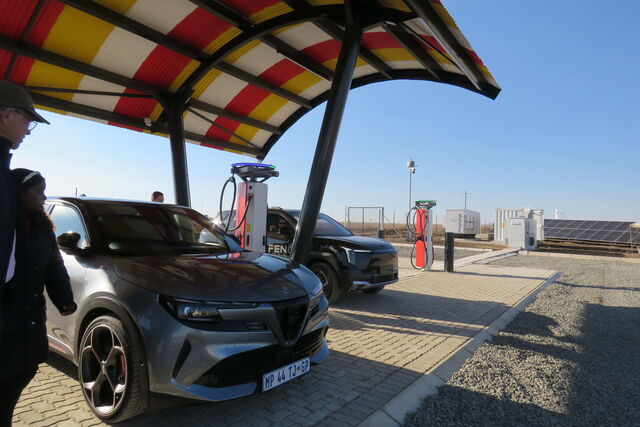
Electric vehicle production is receiving increasing government support. EVs and their components have been incorporated into Phase 2 of the Automotive Production and Development Programme (APDP), while a 150% tax allowance for investment in battery-electric and hydrogen-powered vehicle manufacturing came into effect earlier this year.
However, concerns remain that the current tax structure continues to make imported EVs significantly more expensive for consumers, limiting demand at a time when local production capacity is still developing.
Zero Carbon Charge (CHARGE) has urged National Treasury to use the upcoming Medium-Term Budget Policy Statement (MTBPS) on 21 October to provide greater certainty on future EV taxation and charging infrastructure support.
According to the organisation, imported EVs can face a combination of customs duties, ad valorem excise duties and VAT that substantially increases their retail price. This, it argues, creates a disconnect between efforts to encourage local manufacturing and the need to build a strong domestic market for electric vehicles.
CHARGE believes the MTBPS provides an opportunity for government to outline a clear policy direction that supports both industry growth and consumer adoption.
Among its proposals are a review of customs duties and ad valorem taxes applied to EVs, ensuring they are not taxed more heavily than comparable internal combustion engine vehicles. The organisation has also called for targeted incentives aimed at making lower-priced EVs more accessible to consumers.
Beyond vehicle affordability, CHARGE argues that investment in charging infrastructure will be critical to the success of South Africa’s EV transition. It has proposed dedicated funding for renewable energy microgrids linked to charging stations, as well as access to long-term concessionary financing for infrastructure developers.
The group notes that expanding charging networks and increasing EV adoption are closely linked. Wider access to reliable charging facilities can improve consumer confidence, while higher vehicle uptake strengthens the business case for additional infrastructure investment.
CHARGE further believes renewable-powered charging stations can contribute to energy security while reducing pressure on the national electricity grid. The company points to its existing off-grid solar-powered charging installations as evidence that locally produced renewable energy can play an important role in supporting electric mobility.
With government continuing to refine its automotive industrial strategy, the MTBPS could offer an indication of how South Africa intends balancing support for domestic manufacturing with measures aimed at growing the local EV market.
Audio statement by Joubert Roux, Co-founder and Director of Zero Carbon Charge:
Artificial Intelligence (AI) can play a vital role for customers to make the right choice when hunting for a pre-owned vehicle.

The South African motor industry has lost one of its longstanding business figures following the passing of Jebb McIntosh, the group chief executive of Combined Motor Holdings (CMH), on Monday, 2 November 2026.

“South Africa’s automotive industry has been AGOA’s largest user, but for the sector the preference has already been largely overridden by the 25% Section 232 tariffs applied on vehicles and components. Losing AGOA adds a further cost to an industry that has already absorbed a significant shock.”
 Advertisement
Cars are the ultimate symbol of freedom, independence and individualism. They offer the freedom to ‘go anywhere,’ whenever it suits and with whom one chooses.
Sarah Redshaw
India, the largest source of passenger vehicle imports for South Africa, has finalised its fuel efficiency standards for passenger vehicles.
South Africa’s new energy vehicle (NEV) market continued to expand during 2026, with sales for the first nine months of the year already exceeding the total recorded during the whole of 2025.
Charging time remains a worry for many South Africans considering an electric vehicle, who still see it as a disruption rather than a quick stop at a filling station. That view is starting to shift.