The lower fuel costs helped offset the impact of the full reinstatement of the General Fuel Levy, easing pressure on household and operating budgets and contributing to a more supportive environment for vehicle demand. Against a backdrop of persistent economic headwinds, the market demonstrated steady underlying momentum as the industry commenced the third quarter on a positive note.
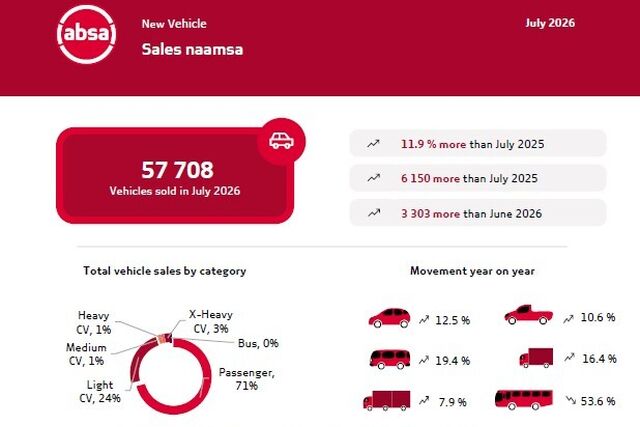
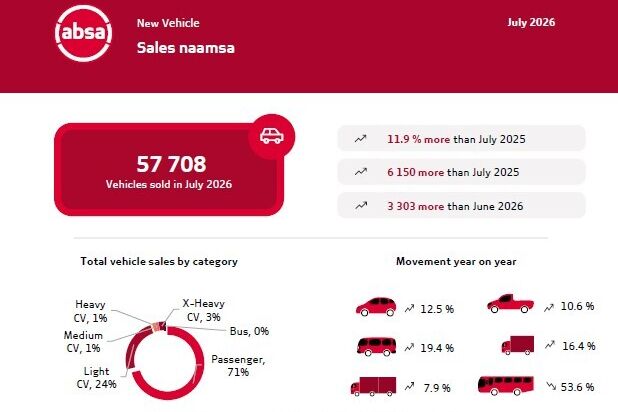
Aggregate domestic new vehicle sales in July 2026 reached 57 708 units, representing an increase of 6 150 units, or 11,9%, compared to the 51 558 vehicles sold in July 2025. In contrast, export volumes reached 32 801 units, a decrease of 11,6% relative to the 37 114 units shipped in July 2025.
Overall, of the total reported industry sales of 57 708 vehicles, an estimated 48 949 units, or 84,8%, represented dealer sales. An estimated 11,2% represented sales to the vehicle rental industry, while 2,2% were government sales and 1,8% were sales to industry corporate fleets.
The July 2026 new passenger car market, at 40 912 units, reflected the best monthly passenger car figures since September 2014, with an increase of 4 558 units, or 12,5%, compared to the 36 354 new cars sold in July 2025.
Car rental sales accounted for a healthy 13,8% of new passenger vehicles sold during the month. Domestic sales of new light commercial vehicles (bakkies and minibuses), at 13 710 units during July 2026, recorded an increase of 1 309 units, or 10,6%, compared to the 12 401 units sold in July 2025.
Sales in the medium and heavy commercial vehicle segments also performed well during July 2026. Medium commercial vehicles recorded an increase of 137 units, or 19,4%, to 843 units, compared to the 706 units sold in July 2025, the strongest month for medium commercial vehicle sales since March 2023. Heavy trucks and buses, at 2 243 units in July 2026, reflected an increase of 146 units, or 7,0%, compared to the 2 097 units sold in July 2025.
Exports remained under pressure in July 2026, with vehicle export sales reaching 32 801 units, down by 4 313 units, or 11,6%, compared to the 37 114 units exported in the corresponding month last year.
Commenting on the latest market performance, naamsa CEO Shinny Gobiyeza says the results reflected an automotive industry that continues to adapt successfully to changing market conditions while responding to evolving consumer preferences.
"The continued growth in domestic vehicle sales, coupled with record levels of New Energy Vehicle adoption, demonstrates the resilience of South Africa's automotive industry. While export markets remain under pressure from global economic conditions, the domestic market continues to provide an important foundation for industry growth.
"Equally significant is the accelerating uptake of electrified vehicles across multiple technologies, confirming that South Africa is steadily progressing towards a more diversified and sustainable mobility future," she concludes.
More results here: AVAF Infographic July 2026