Owing to the limited availability of hydrogen refuelling infrastructure, high capital requirements, and the need for stronger consumer purchasing incentives, the Company does not anticipate the adoption of hydrogen-powered light commercial vehicles before the end of the decade.
As a result, Stellantis will no longer launch its new range of hydrogen-powered Pro One vehicles this year. Serial production was scheduled to start this summer in Hordain, France (medium-sized vans) and Gliwice, Poland (large vans).
“In a context where the Company is mobilising to respond to demanding CO2 regulations in Europe, Stellantis has decided to discontinue its hydrogen fuel cell technology development programme,” explains Jean-Philippe Imparato, Chief Operating Officer for Enlarged Europe.
“The hydrogen market remains a niche segment, with no prospects of mid-term economic sustainability. We must make clear and responsible choices to ensure our competitiveness and meet the expectations of our customers with our electric and hybrid passenger and light commercial vehicles’ offensive.”
This decision will not impact staffing at Stellantis’s production sites. R&D activities related to hydrogen technology will be redirected to other projects.
The current state of the hydrogen segment also presents financial challenges for various stakeholders. In this context, Stellantis has initiated discussions with the shareholders of Symbio to evaluate the current market consequences and to preserve the best interests of Symbio, in line with their respective obligations.
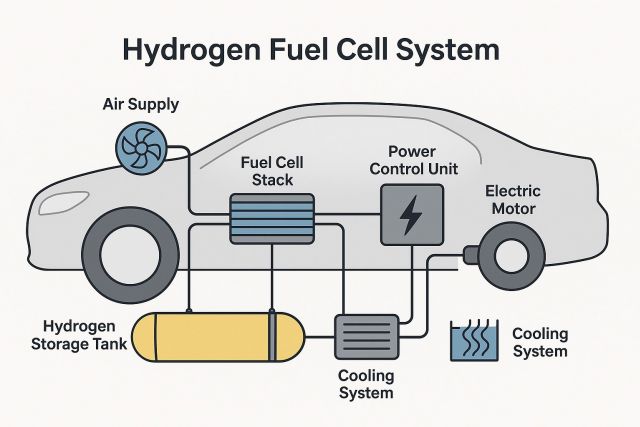
- Although Hydrogen is not something of the past. It is taking a back seat when compared to the normal electric vehicle with power coming from batteries. Or like it is described: “Hydrogen isn’t dead – it’s just not the main act. Think of it as the specialist, while EVs are becoming the everyday hero.”
- Toyota and BMW are working closely together on Hydrogen development. The Hydrogen fuel-cell SUV based on the X5 with 295kW combined output and a 504km range is not yet commercially available. BMW is running global pilot tests, including in South Africa, with plans for production in 2028, according to sources.
- In South Africa, BMW is testing the iX5 locally with Sasol and Anglo-American Platinum to explore hydrogen viability.
- Toyota has the Mirai Hydrogen, a fuel-cell sedan with a range of up to 500km. It refuels in minutes with zero emissions except water. It is commercially available in select global markets in Japan, the USA and Europe.
- Toyota also has a Hilux Hydrogen Prototype fuel-cell bakkie with a 600km range, using the Mirai’s core tech. It is still only a prototype.