Charging an electric truck with off-grid solar power
A historic milestone has been reached with the opening of South Africa's first off-grid solar station for electric trucks.
Share with friends
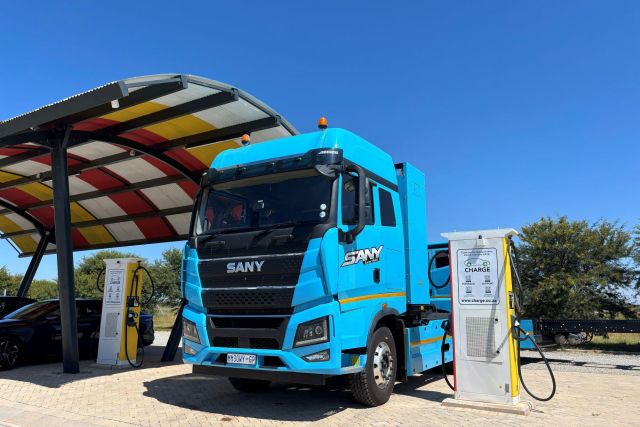
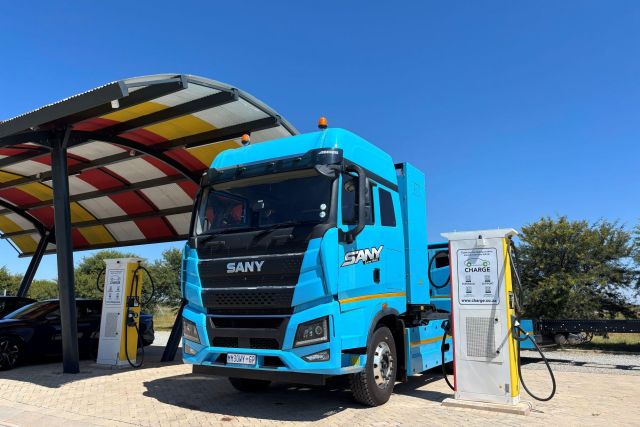
The new truck charger will be part of Zero Carbon Charge's (CHARGE) solar powered charging station on the N12 at Wolmaransstad in the Northwest, between Johannesburg and Kimberley.
CHARGE says this marks a national first and signals that electric freight, powered entirely by renewable energy and independent of the national grid, is no longer a future concept but a present-day reality.
The milestone coincides with one year of operations at CHARGE Wolmaransstad, where provincial government leaders, investors and strategic partners gathered to witness what is widely regarded as a breakthrough moment for green mobility and logistics in South Africa.
"This is a great milestone, not only for CHARGE, but for South Africa," says Joubert Roux, co-founder and chair of Zero Carbon Charge. "What we demonstrated today is the beginning of the future of green mobility. Electric trucks are going to become a reality sooner than passenger EVs, because the economics, the routes and the operational logic all align. This is where the transition truly accelerates."
In partnership with global commercial vehicle manufacturer SANY, electric trucks were charged entirely from CHARGE's solar generation and battery storage, becoming the first electric trucks to ever charge at a CHARGE station.
Avinash Singh, sales and marketing director for SANY South Africa, says the working partnership with CHARGE over the past year makes this a special moment, demonstrating that SANY trucks are now in South Africa and charging for the first time at a CHARGE station on solely renewable energy.
With CHARGE actively developing a national network of solar powered EV charging stations across South Africa's major highways, the focus is now shifting to freight corridors. The next dedicated electric truck charging sites are set to launch along the N3 corridor this year, positioning South Africa's busiest logistics route at the forefront of the energy transition.
Free State MEC for Economic Development, Tourism and Environmental Affairs, Moses Ketso Makume, welcomed the rollout. "We are excited to be one of the first provinces with sites developed on the N3 that will also charge electric trucks. The Free State is proud to be part of mitigating climate change whilst actively driving the future economy and sustainable logistics."
The milestone was also welcomed by development finance partners. Spiwe Sibanda, head of product innovation at the Development Bank of Southern Africa (DBSA), said the demonstration reinforced the bank's confidence in the project. "What we saw today reinforces DBSA's faith in CHARGE's business model and its role in building South Africa's green infrastructure."
Few can claim a bond with Mazda as deep as the Plitt family's. For more than 60 years, Mazda has been part of the family's story through Mazda Vereeniging, the oldest Mazda dealership in South Africa and a longstanding standalone representative of the brand.
Peugeot has expanded its Landtrek line-up with the addition of a new turbodiesel-powered model aimed at buyers looking for increased performance, greater towing capability and updated technology. The latest derivatives join the range from October 2026 and introduce a significant powertrain upgrade for the bakkie.
SMSA Africa Logistics Group has added five Hino 300 diesel electric hybrid trucks with van bodies to its fleet, following a two-year trial of three such trucks in its delivery operation.
South Africa's new energy vehicle market is becoming increasingly diverse, with plug in hybrid electric vehicles (PHEVs) and fully electric vehicles gaining ground while traditional hybrids remain the largest category.
As South Africans celebrate their rich heritage, it is also worth reflecting on a lesser-known chapter of the country's history: its long connection with electric vehicles (EVs).