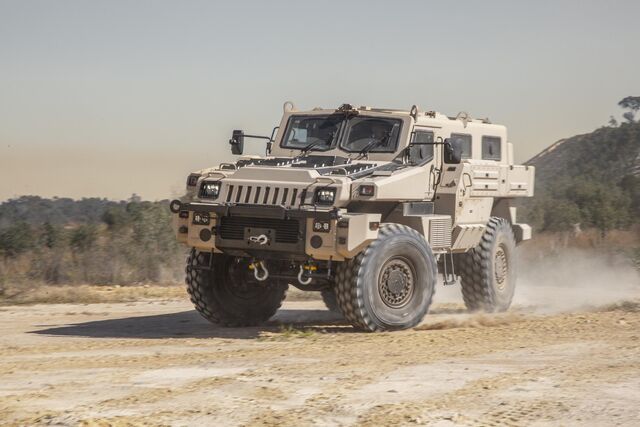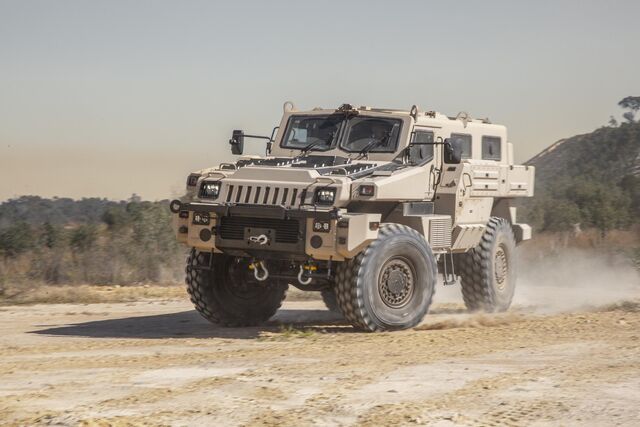
At Paramount South Africa’s armoured vehicle media day recently, the company used the famous testing facility west of Pretoria to make a broader point than simply showing off hardware. Its message was that South Africa still knows how to build world-class defence technology — and should be buying more of it for its own forces.
Dr Mathews Phosa, chairman of Paramount South Africa, opened the event by reminding guests of the country’s defence-industrial pedigree. Platforms such as the Ratel, Rooikat and South Africa’s mine-protected vehicles did not merely serve local requirements; they influenced armoured vehicle design internationally.
“This is not simply history,” he says. “It is a capability that still exists today.”
His central question was direct: if South Africa has the engineers, intellectual property and manufacturing base to produce advanced defence systems, why is it increasingly looking abroad for equipment that can be built at home? He specifically questioned why countries such as China and Turkey are being considered for capabilities South African firms believe they can deliver.
That argument has real urgency. South African soldiers are deployed in difficult environments, including the Democratic Republic of Congo and Mozambique, where protection, mobility, communications and situational awareness are matters of survival rather than luxury. For Mathews, local procurement is not only about supporting business; it is about sovereignty, readiness and responsibility to troops in the field.
Founded in South Africa in 1994, the company now operates across more than 30 countries and supplies land, air, maritime and security solutions. Its armoured vehicle stable includes the Mbombe 4, 6 and 8, as well as the Marauder, Maverick, Maatla and Marshall. The company says more than 500 of its advanced armoured vehicles are in service across Africa.
The Mbombe 8 is particularly relevant to South Africa’s long-running 8x8 infantry fighting vehicle requirement. Project Hoefyster, centred on the Badger vehicle intended to replace the ageing Ratel, has been dogged by delays and industrial difficulties. Paramount argues that its Mbombe 8 offers a modern South African-origin alternative, combining protection, mobility and modularity while sustaining local skills and production capacity.
The company’s ambitions are not confined to domestic procurement. Paramount promotes a “portable production” model, allowing partner countries to assemble, integrate and support vehicles locally while retaining South African-origin technology and design input. It has pursued partnerships in Africa, India, Europe and Central Asia, including the recently unveiled Simha 4x4 with India’s Kalyani Strategic Systems Limited.
Yet that export success also highlights the dilemma. South African defence firms have survived by looking outward, but without a strong home customer the country risks losing design authority, engineering depth and sovereign capability.
As South Africa prepares for Africa Aerospace and Defence 2026, Paramount’s Gerotek message was clear: the country should not only showcase defence technology to the world. It should equip its own forces with technology built here first.