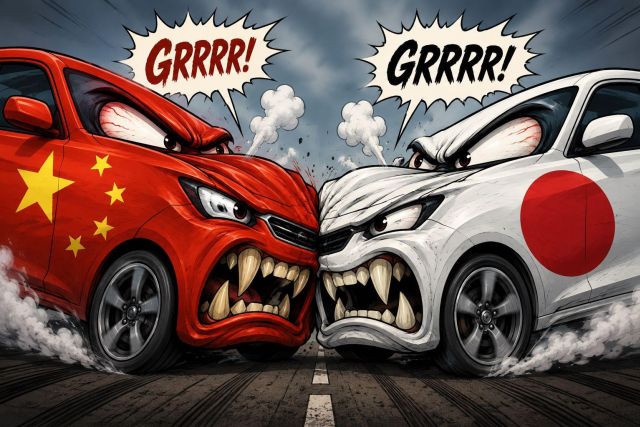
Looking at monthly sales statistics from Naamsa for February, March and April, covering passenger cars and light commercial vehicles (bakkies), Chinese brands outsold Japanese brands at a ratio of roughly five to one.
For the three months under review, the Japanese brands considered were Nissan, Honda, Mazda, Subaru and Mitsubishi. On the Chinese side, the brands included Chery, GWM, Jetour, Omoda & Jaecoo, Foton, Changan, BYD and MG.
Total volumes for the three months were 5 647 units for the Japanese group and 29 478 units for the Chinese. Brands such as Chery and GWM each outsold the combined total of the Japanese competitors, with more than 7 000 units apiece.
Several Chinese nameplates individually outperformed entire Japanese rival groups. For example, the Chery Tiggo 4 Pro recorded 1 809 sales in February, 1 888 in March and 1 871 in April. In all three months, the Tiggo 4 Pro alone outsold the combined totals of Honda, Mazda, Mitsubishi and Subaru.
The Nissan Magnite (in the Japan group) remained Nissan’s strongest performer with 719 units in February, 953 in March and 475 in April. Meanwhile, the GWM P-Series sold 559 units in February, 785 in March and 588 in April, making it one of the strongest Chinese light commercial performers. The Jetour Dashing managed 396 sales in February, 414 in March and 305 in April.
However, Indian-manufactured Japanese cars (mostly Toyota and Suzuki) came to the rescue of Japanese brands in South Africa. Over the three months, Toyota contributed 49 751 units while Suzuki added 16 972. Together, they pushed Japanese sales to 72 370 units, compared with the Chinese total of 29 478. This gave Japanese brands an advantage with a ratio of 2.5 to 1 against their Chinese competitors.
Legacy brands such as Mazda, Mitsubishi, Nissan, Honda and Subaru are feeling the pinch from the Chinese assault, as are numerous European marques. Korean brands, however, seem to be holding the line for now.
According to industry sources such as Lightstone, around the year 2000 Toyota, Volkswagen, Nissan, Opel, Mazda and Ford were the six biggest-selling brands, holding 60 to 70% of the market. By 2025, the top five brands in South Africa were Toyota, Suzuki, Volkswagen, Hyundai and Ford.
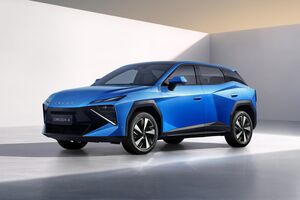
Combining all the brands under the Chery Group umbrella (Chery, Jetour, Omoda, Jaecoo and iCaur), the Chinese auto giant was in contention for a podium spot in 2025, fighting off Suzuki and Volkswagen for a place among the top three brands.
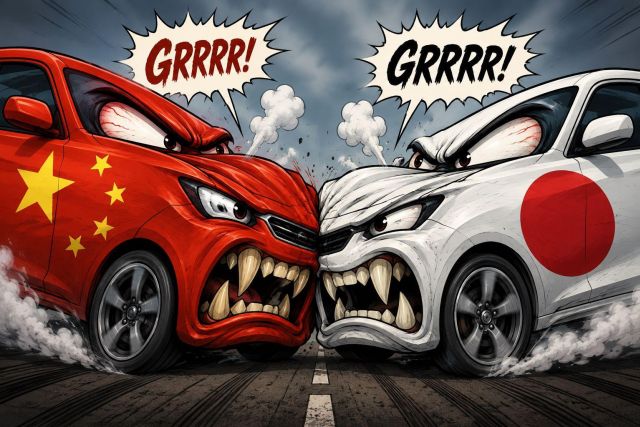
(Image: AI generated).