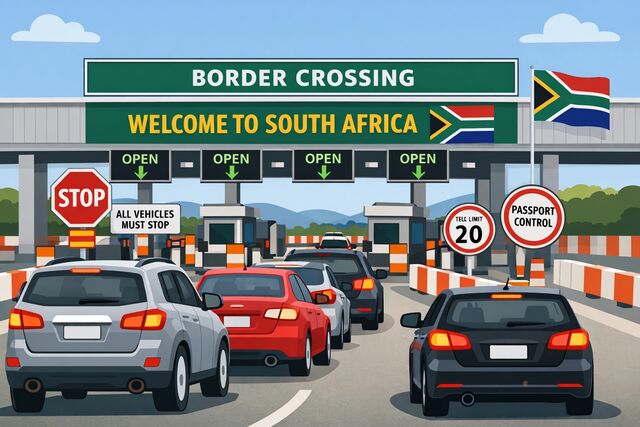
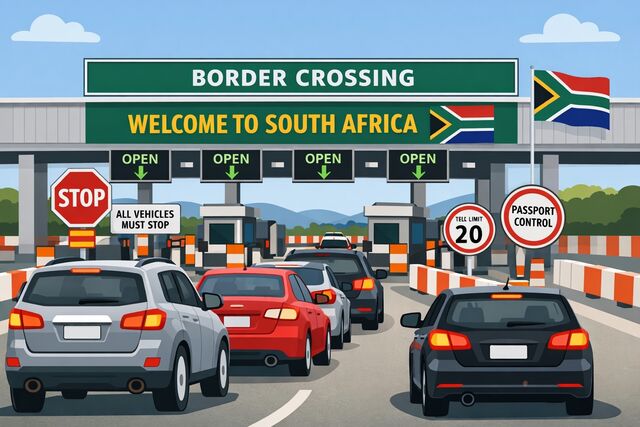
SARS tightens control over foreign registered vehicles at SA’s borders
South Africa has entered a new era of border management with the introduction of the South African Revenue Service's (SARS) digital Traveller Declaration System, which came into effect on 1 June 2026.
Share with friends
The new system requires all travellers entering the country with foreign registered vehicles to declare those vehicles and obtain a Temporary Import Permit (TIP). According to SARS, more than 38 900 TIPs had already been issued by 31 May, indicating strong early compliance ahead of the official launch.
SARS Commissioner Dr Johnstone Makhubu described the initiative as part of a broader effort to modernise border controls, improve compliance and facilitate legitimate trade and travel.
“The obligation to declare goods and vehicles at our borders is firmly rooted in South African law, which clearly states that everyone must declare everything they bring into or take out of the country. As SARS, in collaboration with other state law enforcement agencies have a duty to enforce that law consistently and fairly while making it easy for honest travellers to comply,” he says.
SARS Commissioner Dr Johnstone Makhubu.
The move is based on Section 15 of the Customs and Excise Act, 1964, which requires travellers to declare all goods, including vehicles, when entering or leaving South Africa. Previously, many foreign registered vehicles could enter the country and remain for extended periods with limited oversight, particularly those originating from neighbouring countries.
A key feature of the new system is the Temporary Import Permit, commonly referred to as a TIP. A TIP allows a foreign registered vehicle to be used legally within South Africa for up to six months. The permit remains valid for multiple border crossings during that period, meaning regular commuters, traders, students and tourists do not need to apply for a new permit every time they enter the country. Importantly, SARS has confirmed that obtaining a TIP is free of charge.
One aspect that may surprise many motorists is that the rules apply equally to vehicles from member states of the Southern African Customs Union, or SACU. SACU comprises South Africa, Botswana, Namibia, Lesotho and Eswatini. Although SACU facilitates trade between member countries, SARS has stressed that foreign registered vehicles remain subject to customs controls and must still be declared when crossing South African borders.
“SACU arrangements facilitate trade, but they do not remove customs control. A vehicle registered outside South Africa remains a foreign vehicle under our law and must be declared as such. This approach ensures equal treatment and predictability at all our borders and conforms to our strategic intent of fostering voluntary compliance,” Johnstone adds.
For motorists, the process is relatively straightforward. Travellers can submit their declaration online through the SARS Traveller Management System, the SARS website or the SARS mobile applications before arriving at the border. Once completed, they receive a reference number that must be presented to customs officials. Those unable to complete the process beforehand can still receive assistance at border posts through digital kiosks and SARS staff.
While the system is designed to make life easier for compliant travellers, it also closes loopholes that have long concerned authorities and the automotive industry. Historically, some foreign registered vehicles entered South Africa and were subsequently sold locally without being properly imported. Such transactions often bypassed customs duties, value added tax, vehicle homologation requirements and registration processes. This created unfair competition for local vehicle dealers and reduced tax revenue collected by the state.
Under the new rules, a vehicle imported under a TIP cannot legally be sold in South Africa. Anyone wishing to sell a foreign registered vehicle must first complete the full importation process, pay all applicable duties and taxes, and comply with local registration requirements. The digital tracking system also gives SARS greater visibility over vehicles that overstay their permits or attempt to enter the local market unlawfully.
From an industry perspective, the benefits are significant. Local dealers and importers stand to gain from a more level playing field, while government can improve revenue collection and strengthen oversight of cross border vehicle movements. SARS also believes the system will enhance national security by improving risk based screening and reducing opportunities for smuggling and illicit trade.
There are, however, potential challenges. Frequent cross border travellers who are unfamiliar with the system may initially experience delays, while transport operators and traders will need to ensure administrative compliance. Nonetheless, SARS maintains that the digital approach should ultimately reduce paperwork and speed up border processing for those who follow the rules.
The message from SARS is clear. Foreign registered vehicles are welcome in South Africa, but they can no longer operate outside the customs net. With nearly 39 000 vehicles already registered on the system, authorities believe the new declaration regime will improve compliance, protect legitimate businesses and bring greater transparency to vehicle movements across the country's borders.
Charging time remains a worry for many South Africans considering an electric vehicle, who still see it as a disruption rather than a quick stop at a filling station. That view is starting to shift.
The winners of the 2026 Automotive Business Council | naamsa Accelerator Awards were announced at the recently held Auto Week 2026, which took place in eThekwini, KZN.
When Cobus Coetzee (photo) accepted the opportunity to join the Morgan Group in Upington, he had to weigh up more than a new position. The move meant exchanging the West Coast’s cooler climate and seaside lifestyle for the Northern Cape’s desert heat, while taking responsibility for a multi-franchise operation spread across several premises.
The winners of the 2026 Automotive Business Council | naamsa Accelerator Awards were announced at the recently held Auto Week 2026, which took place in eThekwini, KZN.
With the steep rise in fuel prices since March this year leading to historic record highs following massive increases in October, the government intervention annouched this week, is widely welcomed.
Omoda has confirmed that the new C4 will become the first model from the Chery Group to be built in South Africa, with production set to take place at the company's Rosslyn manufacturing facility in Gauteng.