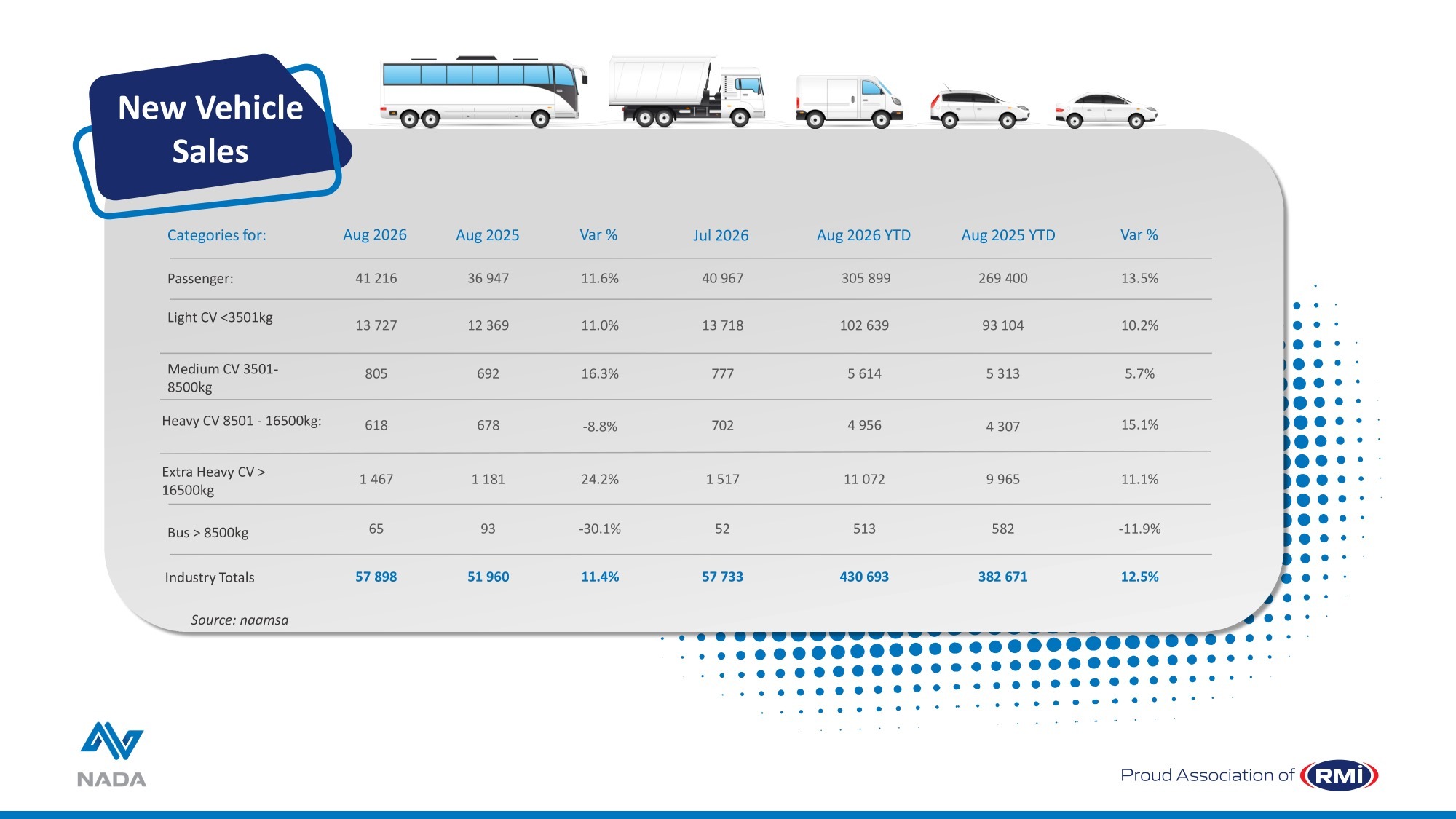
South Africa’s new-vehicle market maintained its momentum in August, with aggregate sales of 57 898 units representing an increase of 11.4% compared with the same month last year.
Share with friends
“The appetite among South African consumers, car rental agencies and businesses for new vehicles remained strong in August, despite continued pressure on household budgets and rising operating costs,” says Brandon Cohen, National Chairperson of the National Automobile Dealers’ Association (NADA).
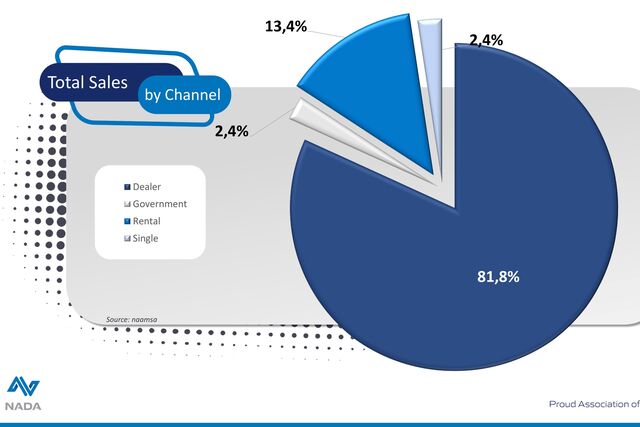
Passenger-car sales increased by 11.6% year on year to 41 216 units, while light commercial vehicle sales rose by 11% to 13 727 units. The vehicle rental industry accounted for 13.4% of total sales and 17.2% of passenger car sales, indicating confidence in the outlook for business and tourism. Dealer networks nevertheless remained the primary route to market, accounting for an estimated 81.8% of all vehicles sold.
Commercial vehicle sales were positive overall. Medium Commercial Vehicle (MCV) sales increased by 16.3%, while extra-heavy commercial vehicle sales rose by a notable 24.2%. Heavy commercial vehicle sales, however, declined by 8.8%, potentially reflecting stock shortages affecting more than one brand.
“The growth in the extra-heavy segment is particularly interesting given rising fuel costs and reduced activity in commodities such as iron ore,” says Martin van den Berg, NADA Regional Executive. “It may point to increased activity in other areas of the economy, including construction, with dealers reporting stronger enquiries for vehicles such as tippers.”
Martin cautioned that diesel price increases of up to R3.15 a litre taking effect in September would place significant pressure on transport and logistics operators, particularly those unable to recover fuel-price fluctuations through their contracts.
While price remains the starting point for many customers, dealers are seeing buyers pay closer attention to the total cost of vehicle ownership.
“Customers are asking more detailed questions about fuel consumption, finance, insurance, servicing, warranties and the products available to protect their vehicles over longer ownership periods,” Brandon explains. “This indicates that the buying process is maturing. Dealers cannot compete on price alone; transparent advice and dependable aftersales support are increasingly important.”
Rising fuel prices are also likely to sustain interest in new-energy vehicles. According to naamsa, 16 289 NEVs were sold during the first seven months of 2026, an increase of 88% compared with the same period last year and already equivalent to 97.5% of total NEV sales in 2025.
“Customers are increasingly asking dealers about hybrids, plug-in hybrids and battery-electric vehicles, but there is no single solution for every motorist,” Brandon says. “The right option depends on the customer’s budget, driving patterns and access to charging infrastructure.”
“Franchised dealers are well positioned to explain these technologies and help customers consider the complete ownership picture. For some, a hybrid may be the most practical route to greater fuel efficiency, while a plug-in hybrid or battery-electric vehicle may suit others.”
Charging time remains a worry for many South Africans considering an electric vehicle, who still see it as a disruption rather than a quick stop at a filling station. That view is starting to shift.
The winners of the 2026 Automotive Business Council | naamsa Accelerator Awards were announced at the recently held Auto Week 2026, which took place in eThekwini, KZN.
When Cobus Coetzee (photo) accepted the opportunity to join the Morgan Group in Upington, he had to weigh up more than a new position. The move meant exchanging the West Coast’s cooler climate and seaside lifestyle for the Northern Cape’s desert heat, while taking responsibility for a multi-franchise operation spread across several premises.
The winners of the 2026 Automotive Business Council | naamsa Accelerator Awards were announced at the recently held Auto Week 2026, which took place in eThekwini, KZN.
With the steep rise in fuel prices since March this year leading to historic record highs following massive increases in October, the government intervention annouched this week, is widely welcomed.
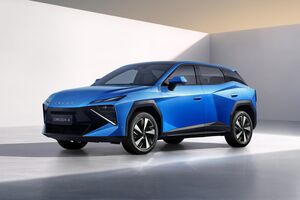
Omoda has confirmed that the new C4 will become the first model from the Chery Group to be built in South Africa, with production set to take place at the company's Rosslyn manufacturing facility in Gauteng.