The German automotive industry has recognised the potential of Africa by strengthening its ties to the continent through a cooperative partnership between the German Association of the Automotive Industry (VDA) and the African Association of Automotive Manufacturers (AAAM).
Share with friends
The establishment of the partnership coincided with the launch of the African Continental Free Trade Area (AfCFTA) on January 1 2021. The AfCFTA will ultimately become the world’s largest free trade bloc, covering a market of initially more than 1.3 billion people and up to $3 trillion dollars in GDP, with the potential of increasing intra-Africa trade by more than 50%. At the same time, estimated sales volumes of new light vehicles in Africa are forecast to double between 2019 and 2027 to 1.8 million vehicles.
VDA President Hildegard Müller said the VDA highly appreciates its partnership with AAAM as the VDA intends to increase its involvement in Africa. The AAAM was established in November 2015 and is the only African body focusing on the expansion and deepening of the automotive industry across the continent.
The establishment of the partnership coincided with the launch of the African Continental Free Trade Area (AfCFTA) on 1 January 2021. The AfCFTA will ultimately become the world’s largest free-trade bloc, covering a market of initially more than 1.3 billion people and up to $3 trillion dollars in GDP, with the potential of increasing intra-Africa trade by more than 50%. At the same time, estimated sales volumes of new light vehicles in Africa are forecast to double between 2019 and 2027 to 1.8 million vehicles.
VDA President Hildegard Müller said the VDA highly appreciates its partnership with AAAM as the VDA intends to increase its involvement in Africa. The AAAM was established in November 2015 and is the only African body focusing on the expansion and deepening of the automotive industry across the continent.
It plans to achieve its aims by working with governments to shape and implement policies that will attract investors, unlock the economic potential of the continent and align a global network of stakeholders committed to the development of the automotive industry in Africa.
Müller said the VDA and AAAM are jointly pursuing the goal of creating improved conditions for a flourishing automotive industry in Africa to increase economic growth and welfare on the continent and enable German and African member companies to participate in market growth and foster win-win trade and investments between Europe and Africa.
“This commitment of the VDA and AAAM is a significant contribution to growth and prosperity in Africa, supported by the investments of car manufacturers and suppliers on this emerging continent,” she said.
An in-house cluster for the association partnership at VDA’s headquarters in Berlin and two project offices in South Africa and Ghana are now responsible for project implementation and supporting direct local contacts for members and partners.
VDA President Hildegard Müller
Significant potential in Africa
The motorisation rate in Africa is only 45 vehicles per 1 000 inhabitants, which is significantly below the global average of 203 vehicles per 1 000 inhabitants.
A total of 869 000 new passenger vehicles were sold in African markets in 2019, with the continent regarded as having great potential as a market and production location for the German automotive industry.
German automotive manufacturers and suppliers have in recent years increasingly made several investments on the continent, not only in the established markets of the Maghreb region (Northwest Africa) and South Africa, but also in future markets such as Ghana and Rwanda.
A total of 62 000 passenger cars were exported from Germany to Africa in 2019, with 49% of them exported to South Africa, the major market in Africa. German original equipment manufacturers (OEMs) accounted for 34% or 119 000 of the 355 000 passenger cars sold in South Africa in 2019.
Since 2010, German OEMs have increased their production in South Africa by 44% to 317 000 passenger cars in 2019, which means that 91% of passenger car production in South Africa is carried out by German manufacturers.
AAAM CEO, Dave Coffey, said their experts estimate that the African new vehicle market can initially grow to three million vehicles by 2035. However, Coffey said Africa has the potential to achieve five million new vehicles sales by implementing effective automotive policies and ecosystems.
AAAM CEO Dave Coffey
“We are excited about our partnership with the VDA as it will provide expertise, resources and a strong network that will facilitate the development of the automotive industry in Africa,” he said.
Coffey added the launch of the AfCFTA is an important milestone for the realisation of the AAAM’s vision of building a successful automotive ecosystem that will lead to a sustainable industry that creates significant jobs and assists in the industrialisation of the auto sector in Africa. He said it is anticipated that the Rules of Origin for the automotive industry will be concluded by mid-2021, paving the way for real industrialisation of the sector across the continent.
“Effective industrialisation is fundamental to the journey of becoming competitive and to the subsequent liberalisation of tariffs across Africa – the AfCFTA will provide the scale that is required for industrial competitiveness. The AAAM is fully committed to supporting the Secretariat of the AfCFTA in realising the vision of creating demand and production for five million new vehicles per annum from the 2019 level of 1.1 million.
“This growth requires the implementation of progressive automotive policies and ecosystems across the continent, where hub countries in regions will assemble vehicles supported by surrounding economies sharing in the value chain, and regional markets ultimately trading vehicles and components,” he said.
Charging time remains a worry for many South Africans considering an electric vehicle, who still see it as a disruption rather than a quick stop at a filling station. That view is starting to shift.
The winners of the 2026 Automotive Business Council | naamsa Accelerator Awards were announced at the recently held Auto Week 2026, which took place in eThekwini, KZN.
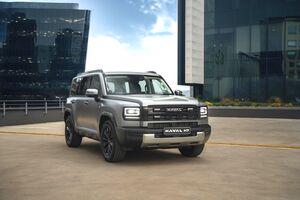
GWM has expanded its local SUV line-up with the introduction of the all-new Haval H7. Replacing the outgoing model, the newcomer blends boxy styling, advanced technology and a choice of petrol, hybrid and plug-in hybrid powertrains, giving buyers a versatile family SUV with genuine all-terrain credentials.
The winners of the 2026 Automotive Business Council | naamsa Accelerator Awards were announced at the recently held Auto Week 2026, which took place in eThekwini, KZN.
With the steep rise in fuel prices since March this year leading to historic record highs following massive increases in October, the government intervention annouched this week, is widely welcomed.
Most motorists will go their entire driving lives without deliberately pushing their vehicle to the limits of adhesion. Yet a sudden downpour, a patch of gravel, standing water or simply carrying too much speed into a bend can quickly expose the limits of a vehicle's grip.