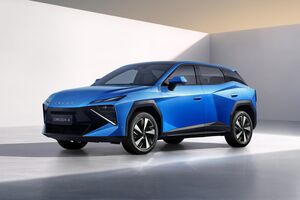
Chinese brands move from challengers to major force
Chinese vehicle manufacturers are no longer simply disrupting South Africa's automotive market. They are becoming an established part of the industry, expanding their market share, strengthening consumer confidence and beginning to reshape manufacturing, financing and competition.
Share with friends
These trends are highlighted in the Q1 2026 Mobility Report by TransUnion, which shows that Chinese brands have entered a new phase of growth that extends well beyond competitive pricing.
The South African passenger vehicle market remained resilient during the first quarter of 2026, with new passenger car sales reaching 114 517 units, slightly above the previous quarter despite growing macroeconomic uncertainty. Year on year growth reached 12.6 per cent, supported by favourable financing conditions, improved affordability over the past year, competitively priced imports and recovering consumer confidence.
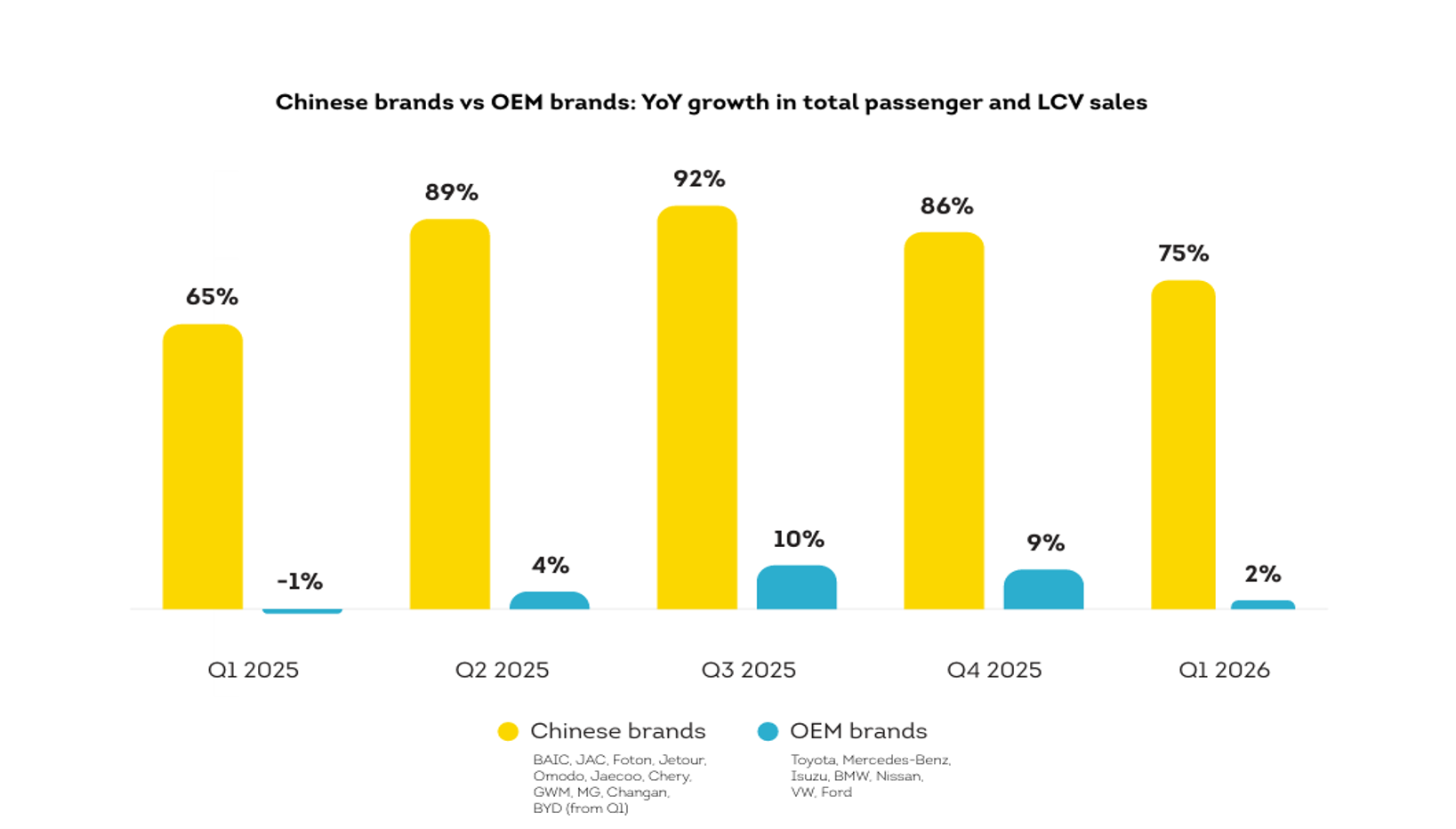
Within this broader recovery, Chinese manufacturers continued to outperform the rest of the market. According to the report, sales by Chinese original equipment manufacturers (OEMs) increased by 75 per cent compared with the first quarter of 2025. Although this represented a moderation from the 86 percent growth recorded in the previous quarter, it remained significantly stronger than the overall market and well ahead of the growth achieved by most established manufacturers.
The accompanying market share data illustrates the scale of this shift. Chinese brands now account for more than 19 percent of South Africa's new passenger vehicle market, meaning almost one in every five new vehicles sold nationally comes from a Chinese manufacturer.
The report highlights particularly strong growth among newer entrants, with Jetour recording growth of 249 per cent, Foton 171 per cent and Omoda and Jaecoo 79 per cent. Over the same period, the combined market share of several long established manufacturers declined to below 49 percent.
The report argues that this transition has moved beyond a simple pricing battle. Early success was largely driven by offering well specified vehicles at competitive prices. Today, the competitive landscape is becoming broader, influencing manufacturing investment, dealer expansion, financing models, ownership patterns and industrial policy.
One of the most significant developments is the emergence of local manufacturing ambitions. The report identifies Chery's acquisition of Nissan's Rosslyn manufacturing assets as an important milestone. The factory, land and stamping facilities are expected to be decommissioned and retrofitted over the next 12 to 18 months, with production targeted to begin during 2027. Planned production is expected to include hybrid, plug-in-hybrid (PHEV) and battery electric vehicles (EVs).
The report notes that the planned investment reflects more than local demand. Export ambitions into African and European markets position the Rosslyn facility as a potential regional manufacturing hub rather than simply a domestic production plant. It also points out that the combined sales of Chery, Jetour, Omoda and Jaecoo now exceed those of the Nissan operation they are effectively replacing, illustrating how changes in market demand are beginning to influence manufacturing capacity.
The report also indicates that discussions involving manufacturers including BYD, Suzuki and Proton suggest localisation could become an increasingly important competitive strategy as the market continues to evolve.
Ownership confidence is strengthening alongside this expansion. Historically, concerns about resale values, parts availability and long term ownership limited the appeal of Chinese vehicles. According to the report, many of these barriers are beginning to weaken.
As more Chinese vehicles enter the used vehicle market, buyers have greater visibility of long term ownership performance. Improved dealer networks, stronger parts supply and wider market acceptance are helping to improve residual value perceptions. This is increasing confidence among lenders while also reducing uncertainty surrounding insurance and long term ownership costs.
The implications extend throughout the automotive sector. Dealer networks, finance providers and component suppliers are all adapting to changing market dynamics as Chinese brands continue to expand. At the same time, the report notes that higher import volumes place increasing pressure on local component manufacturers and raise important questions about local content and industrial competitiveness.
Government policy could also play a growing role. South Africa currently applies a 25 per cent import duty on fully built passenger vehicles, while discussions continue around possible measures to encourage greater localisation. The report makes clear that these remain policy discussions rather than implemented changes. It notes that policymakers face the challenge of balancing consumer affordability with the need to support local manufacturing, investment and employment.
Overall, the report concludes that South Africa is moving beyond a period of Chinese market disruption into one of structural repositioning. The data suggests Chinese manufacturers are becoming established competitors with growing industrial ambitions, improving ownership credentials and an expanding presence across virtually every segment of the country's automotive market.
Charging time remains a worry for many South Africans considering an electric vehicle, who still see it as a disruption rather than a quick stop at a filling station. That view is starting to shift.
The winners of the 2026 Automotive Business Council | naamsa Accelerator Awards were announced at the recently held Auto Week 2026, which took place in eThekwini, KZN.
When Cobus Coetzee (photo) accepted the opportunity to join the Morgan Group in Upington, he had to weigh up more than a new position. The move meant exchanging the West Coast’s cooler climate and seaside lifestyle for the Northern Cape’s desert heat, while taking responsibility for a multi-franchise operation spread across several premises.
Cars are the ultimate symbol of freedom, independence and individualism. They offer the freedom to ‘go anywhere,’ whenever it suits and with whom one chooses.
The winners of the 2026 Automotive Business Council | naamsa Accelerator Awards were announced at the recently held Auto Week 2026, which took place in eThekwini, KZN.
With the steep rise in fuel prices since March this year leading to historic record highs following massive increases in October, the government intervention annouched this week, is widely welcomed.
Omoda has confirmed that the new C4 will become the first model from the Chery Group to be built in South Africa, with production set to take place at the company's Rosslyn manufacturing facility in Gauteng.