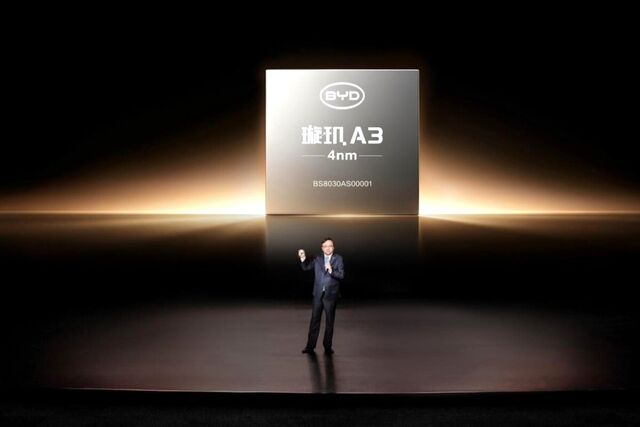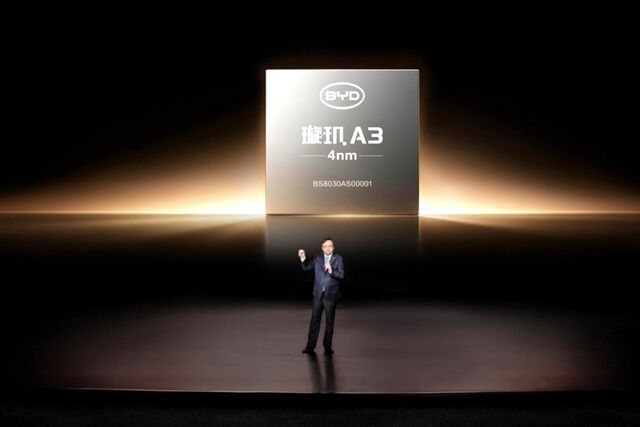
The company made the landmark announcement at its Intelligence Strategy Launch Event, where it also unveiled China’s first 4nm (nanometre) automotive Driving SoC (System on a Chip), the XUANJI A3. An SoC is an integrated circuit that combines all the essential components of a computer onto a single microchip.
With this new pledge, following its commitment to Intelligent Parking, BYD has now become the world’s first automaker to offer such dual coverage for its advanced driving assistance systems (ADAS). Furthering its “Intelligent Driving for All” strategy, BYD also announced that its entire vehicle lineup can now be optionally equipped with the God’s Eye-B Intelligent Driving System LiDAR Version.
BYD’s vision for the era of Intelligent Driving is defined by three ambitious goals of achieving Zero Traffic Accidents, enabling the ADAS to serve as a Super Driver, and empowering AI to become a Super Personal Assistant. To realize this vision, the company will continue to invest over RMB 100 billion in Intelligent Driving Assistance R&D, focusing on safety technologies for every family.
The one-year Full Damage Coverage guarantee applies to new buyers and existing owners who upgrade to God's Eye - BYD Intelligent Driving System 5.0 in the Chinese market. The policy states that if a legally-liable accident occurs while a user is operating the Urban NOA function in compliance with regulations, BYD will directly cover all resulting economic losses.
The confidence to make this industry‑leading commitment rests on three foundational pillars. The first is its massive scale, with a fleet of over 3.15 million Intelligent Driving Assistance vehicles on the road, the largest among Chinese automakers, providing an unparalleled foundation of real‑world data for continuous iteration.
The second is the abundant data generated by the God's Eye - BYD Intelligent Driving System, with over 200 million kilometres logged daily, ensuring rapid algorithmic learning and improvement. The third pillar is a dedicated R&D team of 5 000 engineers, the largest in China’s automotive industry, powering the company’s sustained technological innovation.
The God's Eye - BYD Intelligent Driving System receives four major upgrades. These include a new XUANJI Architecture 2.0, an industry‑first satellite sensor architecture, an upgraded physical AI large model, and a self‑evolving data flywheel built on massive real‑world scenarios.
In the cockpit, BYD introduced the DiLink AI Intelligent Cockpit, featuring the super intelligent agent. This hyper‑realistic digital assistant offers proactive task execution and deep reasoning capabilities, delivering an all‑scene, continuously evolving in-car experience.
BYD unveiled the XUANJI A3, China’s first self‑developed 4nm automotive‑grade Driving SoC. It natively supports L3 and L4 autonomous driving, and a three-chip configuration can deliver over 2 100 TOPS (Trillion Operations Per Second) of computing power per vehicle.
With the most advanced 4nm process and the lowest power consumption per TOPS, 20% lower than comparable products, the XUANJI A3 is already in mass production. When combined with BYD’s proprietary algorithms, it doubles computing utilization, significantly raising the ceiling for both safety and performance.
In the industry’s electrification phase, the Blade Battery was BYD’s answer to user concerns about safety. Now, in the era of Intelligent Driving, BYD applies the same core principle. The company’s strategy is to push the limits of ADAS capabilities with the God's Eye - BYD Intelligent Driving System to bolster user confidence through its Full Damage Coverage pledge, and shape the future of mobility with self-developed technologies like the XUANJI A3 chip, it states.