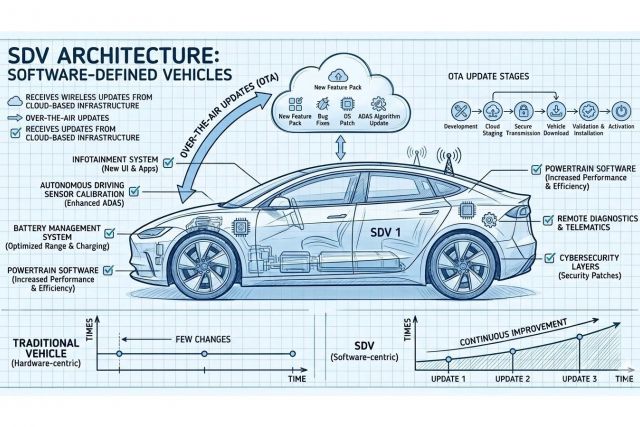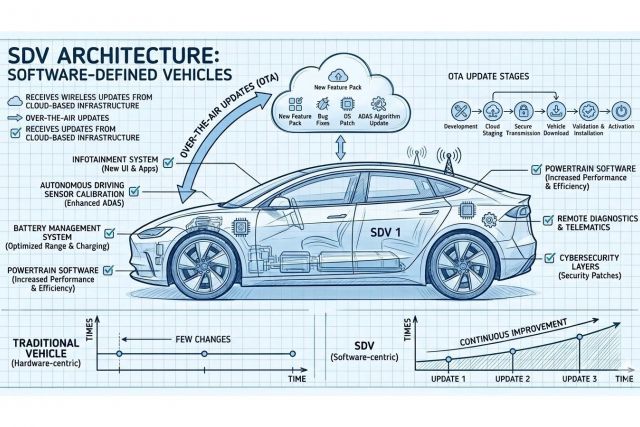
In an SDV, software plays the central role in controlling vehicle functions, rather than those functions being fixed by hardware at the factory. This means a car can gain new capabilities or improved performance throughout its lifespan, much like a smartphone or computer system.
From hardware led to software led design:
Traditional vehicles rely on dozens or even hundreds of electronic control units, each responsible for a specific task such as braking, engine control, lighting or infotainment. As new features were added over the years, vehicles became increasingly complex, heavier and more difficult to maintain or upgrade.
SDVs simplify this structure by consolidating many of these individual units into a small number of powerful central computers. These computers run software that manages multiple systems at once. As a result, functions are no longer tightly tied to specific hardware, allowing manufacturers to update behaviour, performance and features using software alone.
Vehicles that improve over time:
A defining characteristic of an SDV is the ability to receive over the air updates. Using an internet connection, manufacturers can remotely deliver software changes to vehicles without requiring a visit to a dealership. Updates may address safety issues, improve efficiency, refine driver assistance systems or introduce entirely new features.
This continuous improvement model changes the ownership experience. Instead of a car gradually becoming outdated, an SDV can improve as software evolves. Navigation systems can become more accurate, battery management can be refined, and driving functions can become more sophisticated over time.
Relationship to connectivity and automation:
SDVs are often discussed alongside connected and autonomous vehicles, but the terms are not interchangeable. Connected vehicles focus on communicating with external systems such as cloud services, mobile applications or other vehicles. SDVs focus on the internal software architecture that enables flexible control and rapid change.
Advanced driver assistance and autonomous driving depend on large amounts of software and computing power. For this reason, higher levels of automation are only practical within an SDV architecture that supports centralised processing and frequent updates.
Why SDVs are important:
As the automotive industry evolves, software is becoming the main source of innovation and differentiation. Digital experiences, regular updates and feature flexibility are increasingly important to customers.
In essence, SDVs transform cars from static mechanical products into adaptable digital platforms, extending their value well beyond the moment they leave the factory.