SA’s automotive heartlands where vehicles are built and sold
South Africa’s automotive industry is one of the country’s most vital manufacturing sectors, driving exports, employment, and economic activity. Vehicle production is concentrated in a few strategic provinces, while demand is spread nationwide, with sales strongest in the major economic centres.
Share with friends
Manufacturing footprint:
According to naamsa | The Automotive Business Council’s Trade Manual 2026, South Africa’s automotive manufacturing is concentrated in Gauteng, KwaZulu-Natal (KZN), and the Eastern Cape (EC). These provinces have evolved into specialised clusters supporting assembly plants, suppliers, logistics, and export facilities. Decades of investment in infrastructure, skilled labour, and supplier networks have created tightly integrated ecosystems that keep manufacturers globally competitive.
Gauteng:
Gauteng is both South Africa’s automotive and economic powerhouse, contributing nearly 34% of GDP and housing a quarter of the population. Despite being landlocked, it benefits from extensive road and rail links to domestic and export markets.
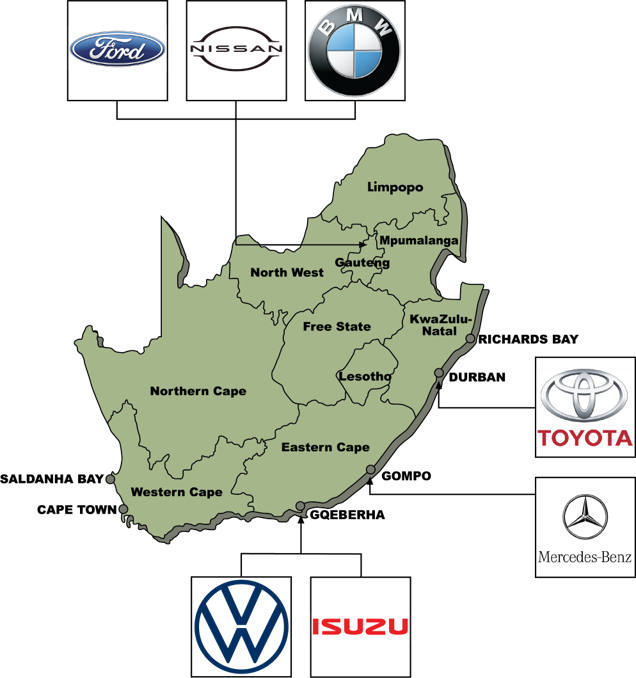
The province hosts three vehicle manufacturers (BMW, Ford and Nissan – Chery going forward) and most first- and second-tier suppliers, centred around Johannesburg and Pretoria. Rosslyn and Silverton are major hubs, supported by the Automotive Supplier Park and Tshwane Automotive Special Economic Zone. Strong logistics links to Durban Port and neighbouring African markets make Gauteng a prime destination for investment.
KwaZulu-Natal:
KwaZulu-Natal forms the second major cluster, anchored by Toyota South Africa Motors in Durban. The province’s strength lies in its coastal location and Durban Port, South Africa’s busiest automotive gateway. A large supplier base, the KwaZulu Natal Automotive Supplier Park, and the Durban Automotive Cluster reinforce its role. The N3 transport corridor connects Durban to Gauteng, ensuring efficient access to domestic and global markets.
Eastern Cape:
The Eastern Cape is South Africa’s leading export-oriented automotive region, with production centred in Gqeberha, Coega, and East London. Deep-water ports and export infrastructure, including the Coega Special Economic Zone and East London Industrial Development Zone, have attracted major investment.
Stellantis’ recent R3 billion facility at Coega highlights the province’s growing importance. In 2025, Eastern Cape manufacturers accounted for the largest share of light vehicle production and exports, underscoring its role as the country’s export hub. It is home to Isuzu, Mercedes-Benz and Volkswagen.
Vehicle sales landscape:
While manufacturing is concentrated in three provinces, sales tell a different story. Based on eNaTIS data, South Africa recorded about 596 818 new vehicle sales in 2025.
Gauteng dominated with 298 000 registrations, nearly half of the national total.
KwaZulu Natal ranked second with 93 000 units (15–16% share)
Western Cape followed with 69 000 registrations (11–12% share)
Eastern Cape and Mpumalanga each recorded about 33 000 units
Limpopo registered 27 000, while North West and the Free State each had around 21 000.
The Northern Cape was the smallest market with 9 000 registrations.
Collectively, Gauteng, KwaZulu Natal, and the Western Cape accounted for two-thirds of all new vehicle registrations, reflecting their economic strength and population density.
Contrasting strengths:
The data highlights a striking contrast: the EC dominates production and exports but represents a relatively small share of domestic demand. Gauteng, by contrast, leads vehicle sales while also serving as a major manufacturing and supplier hub. KZN balances both roles, leveraging its port access and Toyota’s presence.
Outlook:
Together, these regional strengths form the backbone of South Africa’s automotive industry. Manufacturing hubs near ports, transport corridors, and supplier networks drive production and exports, while the country’s economic centres remain the primary destinations for new vehicle sales. With continued investment, these clusters are expected to remain central to South Africa’s industrial and economic growth.
Automotive clusters – key automotive features:
Gauteng
KwaZulu-Natal (KZN)
Eastern Cape (EC)
Number of OEMs (manufacturing plants)
BMW SA, Nissan SA, Ford Motor Company of Southern Africa
Toyota SA Motors
Volkswagen Group Africa, Mercedes-Benz SA, Isuzu Motors SA, Ford Motor Company of Southern Africa Engine Plant
Medium, heavy, extra-heavy commercial vehicle and bus companies
Babcock, Ford, Hyundai Automotive, Iveco, JMC, MAN Truck & Bus, MarcoPolo, Powerstar SA, Scania, Shacman, Stellantis, Tata, UD Trucks, VECH South Africa
Bell Equipment, MAN Truck & Bus, Toyota, Volvo Group Southern Africa
FAW Trucks, Isuzu Motors SA, Daimler Truck Southern Africa, Volkswagen Group Africa
naamsa 2025 employment of 32 115 persons by province
43.6%
30.1%
26.3%
Number of automotive component suppliers
200
80
150
Motor vehicle parc as % of South Africa's total vehicle parc of 13.68 million vehicles
38.5%
13.7%
6.4%
Passenger car sales as % of total 2025 passenger car sales (422 463 units)
35.1%
13.8%
3.7%
LCV sales as % of total 2025 LCV sales (143 964 units)
32.2%
12.1%
4.8%
MCV/HCV sales as % of total 2025 MCV/HCV sales (30 911 units)
38.7%
13.7%
3.6%
Light vehicle production by OEMs in the province as % of total 2025 light vehicle production (585 408 units)
33.8%
25.2%
41.0%
Light vehicle exports by OEMs in the province as % of total 2025 light vehicle exports (412 513 units)
Charging time remains a worry for many South Africans considering an electric vehicle, who still see it as a disruption rather than a quick stop at a filling station. That view is starting to shift.
The winners of the 2026 Automotive Business Council | naamsa Accelerator Awards were announced at the recently held Auto Week 2026, which took place in eThekwini, KZN.
When Cobus Coetzee (photo) accepted the opportunity to join the Morgan Group in Upington, he had to weigh up more than a new position. The move meant exchanging the West Coast’s cooler climate and seaside lifestyle for the Northern Cape’s desert heat, while taking responsibility for a multi-franchise operation spread across several premises.
The winners of the 2026 Automotive Business Council | naamsa Accelerator Awards were announced at the recently held Auto Week 2026, which took place in eThekwini, KZN.
With the steep rise in fuel prices since March this year leading to historic record highs following massive increases in October, the government intervention annouched this week, is widely welcomed.
Omoda has confirmed that the new C4 will become the first model from the Chery Group to be built in South Africa, with production set to take place at the company's Rosslyn manufacturing facility in Gauteng.