The latest figures from naamsa point to a market that remains resilient at home, even as pressures build in the broader economic and global environment.
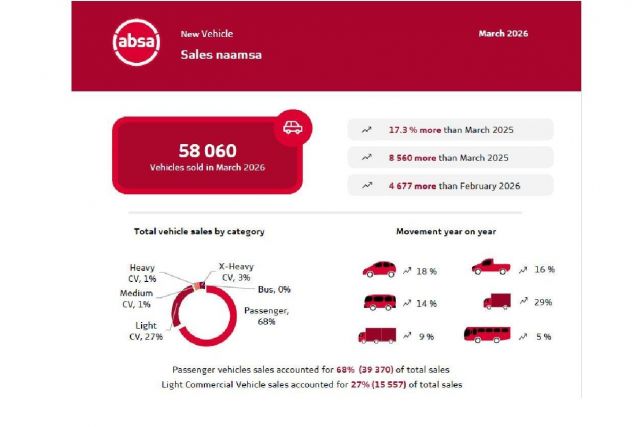
March 2026 total sales reached 58 060 units, up 17.3% year on year. Passenger cars accounted for 39 370 units, while light commercial vehicles totalled 15 557 units. Medium commercial vehicles reached 823 units and heavy trucks and buses 2 310 units. Exports declined to 37 388 units, down 5.3% compared to March 2025.
At first glance, the numbers tell a compelling story of recovery and momentum. Yet beneath the surface, shifting macroeconomic conditions and rising external risks suggest that the current strength may prove difficult to sustain over the medium term.
Domestic demand continues to drive the market’s expansion, supported by improved consumer and business confidence, earlier interest rate cuts, and relatively benign inflation conditions at the start of the year. This combination has created a window of opportunity for the automotive sector, particularly in the retail space where dealer activity remains dominant.
The composition of sales highlights this trend clearly. The vast majority of vehicles sold in March were through dealer channels, reinforcing the role of private buyers and small businesses in sustaining demand. Rental, government, and corporate fleet purchases played a smaller role, underscoring the extent to which the recovery has been led by the retail market rather than institutional buying.
Passenger vehicles were the primary driver of growth, reflecting renewed consumer appetite for personal mobility. This segment has benefited directly from improved financial conditions, including lower borrowing costs and stabilising inflation earlier in the quarter. Light commercial vehicles also recorded solid gains, supported by business activity and demand from sectors such as logistics and small scale enterprise.
The commercial vehicle segments, including medium and heavy trucks, posted moderate but meaningful growth. These categories tend to reflect broader economic investment trends, particularly in infrastructure, freight movement, and industrial activity. Their positive performance suggests that, at least for now, business confidence is translating into tangible capital spending.
However, the export side of the industry tells a different story. Vehicle exports declined during the month, highlighting ongoing challenges in global markets. Geopolitical instability, coupled with structural constraints in key export destinations, continues to weigh on South Africa’s ability to sustain growth beyond its borders. This divergence between strong domestic sales and weaker exports is becoming an increasingly important feature of the market.
The timing of the March sales figures is also notable, coming immediately after the South Africa Investment Conference. Government’s emphasis on investment led growth, infrastructure development, and industrial expansion places the automotive sector at the centre of the country’s economic strategy.
Policy frameworks such as localisation incentives and long term industry planning are expected to support continued development, particularly as the sector begins to align with global shift towards technologies and new energy vehicles.
There is also a growing focus on green industrialisation, with electric vehicle production and battery technologies identified as strategic priorities. This presents an opportunity for South Africa to strengthen its position in global automotive value chains, especially given its access to critical minerals. However, realising this potential will depend on coordinated policy execution across multiple sectors, including energy, mining, and manufacturing.
Despite these supportive structural developments, the macroeconomic outlook has become more uncertain in recent weeks. Earlier gains in consumer confidence, while encouraging, remain uneven. Higher income households have benefited more significantly from improved conditions, while lower income consumers continue to face financial pressure. This limits the breadth of demand and raises questions about the sustainability of the recovery.
Business confidence, on the other hand, has shown stronger improvement, reaching levels not seen in several years. Notably, vehicle dealers have reported particularly high levels of optimism, aligning with the robust sales performance observed in recent months.
Inflation trends, which initially provided a tailwind, are now shifting. Rising geopolitical tensions in the Middle East have driven a sharp increase in global oil prices, leading to substantial fuel price hikes in April. These increases are expected to feed through into higher transport and logistics costs across the economy, placing additional strain on both consumers and businesses.
While temporary tax relief measures on fuel offer some cushioning effect, they are unlikely to fully offset the impact of higher energy costs. As a result, the broader inflation outlook remains under pressure, which could, in turn, affect disposable incomes and vehicle affordability.
The monetary policy environment also reflects this growing uncertainty. Following a period of rate cuts that supported the recovery, the South African Reserve Bank has opted to hold rates steady, signalling a more cautious approach as risks begin to build.
In this context, the strong March performance may represent both a peak and a turning point. The lagged benefits of earlier policy support are still feeding through the system, but the external environment is becoming less favourable.
More results here.