Automotive power shifting east, aftermarket follows
A fundamental realignment in the global automotive ecosystem is shifting the aftermarket’s centre of gravity towards the east, as rapid growth in vehicles manufactured in India and China transforms demand for parts across multiple regions.
Share with friends
This is according to Andre Scholle, Vice President and Head of Region India, Turkey, the Middle East and Africa (MEA), and the Commonwealth of Independent States (CIS) at ZF Aftermarket.
While the United States (US) and Europe remain the largest markets by total value, the speed of growth and the emergence of new manufacturing hubs are driving a geographic rebalancing towards the new growth frontier of India, Africa and the Middle East. China and India have advanced beyond being low-cost producers of passenger, commercial and industrial vehicles and are now becoming primary architects of global mobility across all sectors.
In 2025, China produced a record 34.53 million vehicles, maintaining its position as the world’s largest producer for the seventeenth consecutive year. More importantly, China now accounts for 35.6 per cent of the global automotive market. In South Africa, nearly half of all passenger vehicles sold are manufactured in Asia, reflecting a decisive shift in vehicle sourcing.
Andre Scholle.
India has also strengthened its role across multiple segments of the automotive value chain. The country is now the world’s largest producer of tractors, the second largest manufacturer of buses and the third largest producer of heavy trucks. Overall, Indian vehicle exports rose by 19 per cent in 2025 to reach 5.3 million units. Although car ownership remains relatively low at roughly 22 vehicles per 1,000 people, India already has around 295 million vehicles on the road, highlighting significant long term growth potential.
Asian original equipment manufacturers are not only dominating export markets but are also building strong domestic centres of gravity to support growing local demand. Infrastructure development is accelerating to support this expansion. India’s road network, for example, is expanding rapidly, with approximately 80 000 kilometres added to the national highway system each year to accommodate economic growth and rising vehicle ownership.
This manufacturing expansion is creating strong trailing demand and substantial growth potential for aftermarket parts, while intersecting with powerful trends across Africa. In several African markets, Chinese and Indian vehicle brands now account for nearly 70 per cent of light vehicle sales. This is fundamentally reshaping the aftermarket landscape as vehicles increasingly move away from traditional European specifications.
The African market is also characterised by heavy reliance on used passenger vehicles. In South Africa, more than six million passenger cars are currently out of warranty. This ageing fleet has shifted consumer spending away from official dealerships towards independent workshops, where older vehicles require more frequent and parts intensive maintenance.
In addition, new right to repair legislation in South Africa has dismantled monopolies historically held by original equipment manufacturers, allowing independent workshops to compete more effectively for service business. This regulatory change has directly increased demand for high quality non-OEM aftermarket parts.
Against this backdrop, limited local manufacturing capacity continues to create sustained high-volume demand for quality replacement components. Rather than exporting parts from Europe, established aftermarket manufacturers are decentralising operations and establishing production capabilities closer to emerging centres of gravity. Product ranges are also being adapted to reflect local vehicle populations and operating conditions.
India has become a critical manufacturing hub for parts supply into Africa, benefiting from globally competitive quality standards across both value and premium segments, as well as structurally lower production costs than Europe and Latin America.
Africa is set to play an increasingly important role in this realignment. Countries such as Morocco are emerging as gateways for near shoring parts and vehicle manufacturing into Europe. In 2025, Morocco overtook South Africa as the continent’s leading vehicle producer, with annual output exceeding one million units.
For established aftermarket manufacturers, this eastward shift represents not merely expansion but a fundamental restructuring of business models to align with the forces reshaping the global automotive aftermarket.
The question is no longer whether global growth patterns have changed, but whether organisations are structured to compete effectively in the markets where growth is now taking place, he concludes.
BMW Group South Africa hosted its annual Retailer of the Year Awards celebrating the achievements of its national retail network and recognising the retailers who continue to deliver exceptional customer experiences across the country.
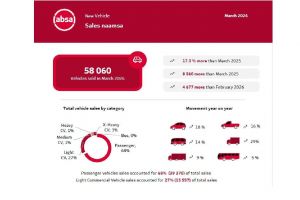
South Africa’s new vehicle market delivered a standout performance in March 2026, extending its domestic growth trajectory to the strongest level seen in nearly two decades.