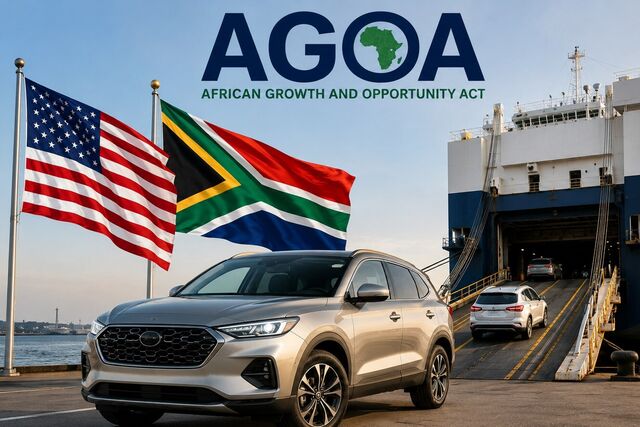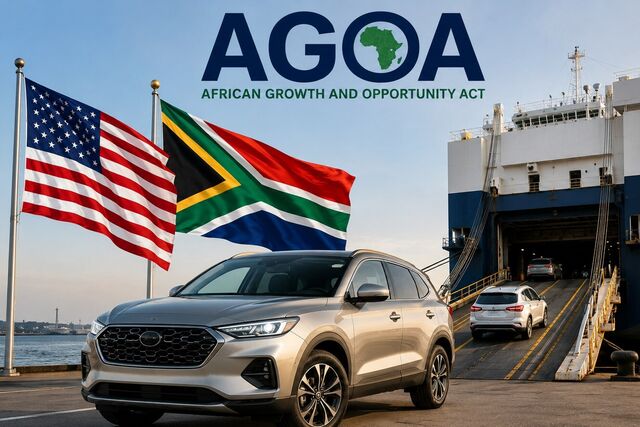
The United States (US) passed the AGOA Extension Act, H.R. 6500, on 8 August 2026. The Senate vote was 90 to six. The legislation would extend the duty-free treatment provided under AGOA until 31 December 2028. However, it is important to note that the legislation has not yet become law. The Senate has approved the measure, but the remaining legislative steps and presidential approval still have to be completed.
For South Africa, and particularly its automotive industry, the proposed extension is significant because AGOA has been an important part of the country's access to the US market for more than two decades.
AGOA was introduced by the US Congress in 2000 to provide eligible sub–Saharan African countries with preferential access to the American market. Qualifying products can enter the US without the normal customs duties, provided they meet the programme's requirements. The aim is to encourage investment, industrialisation, exports and economic development in participating African countries.
The automotive industry has been one of South Africa's biggest beneficiaries. South African manufacturers have used AGOA to export vehicles and components to the US, while the programme has also encouraged investment in local manufacturing and helped integrate South African production into wider African supply chains.
The importance of the US market is clear from the automotive industry's own figures. Naamsa reported that the US was the third largest destination for South African automotive exports in 2024, with approximately R35 billion worth of vehicles exported to the country. That represented about 6.5% of South Africa's total vehicle exports.
The South African government has also specifically identified the motor vehicle manufacturing industry as a major beneficiary of duty-free access to the US under AGOA.
Why the latest extension matters:
AGOA was due to expire in September 2025 and was subsequently given a temporary extension. The latest US legislation would provide a considerably longer period of certainty, taking the programme through to the end of 2028.
That is important for vehicle manufacturers because automotive production is based on long term investment decisions and export programmes. Manufacturers do not simply decide from one month to the next where a vehicle will be produced and where it will be sold. Production allocations, component sourcing, employment and investment decisions can run for several years.
The proposed extension therefore gives manufacturers greater certainty when planning production for the US market.
It also matters to the broader South African automotive supply chain. Vehicles exported from South Africa contain components sourced from other African countries, making the automotive industry an example of the regional value chains that AGOA was intended to encourage. The South African government has previously highlighted how components from countries including Lesotho and Botswana can be incorporated into vehicles manufactured in South Africa and exported to the US.
AGOA does not remove the US tariffs:
The extension should not, however, be interpreted as a return to the tariff conditions that South African vehicle exporters enjoyed before the US introduced its new tariff measures.
This is the most important distinction for the automotive industry.
The United States introduced a separate 25% tariff on imported automobiles under Section 232 in April 2025. This measure is separate from AGOA. AGOA provides preferential treatment under the US trade system, but it does not automatically exempt products from tariffs imposed under separate US national security measures.
US Customs and Border Protection confirms that goods subject to Section 232 tariffs are excluded from the US reciprocal tariff regime.
South Africa was also subjected to a broader US tariff of 30% on its exports from August 2025. The South African Department of Trade, Industry and Competition has pointed out that this substantially eroded the preferential access that South African exporters had previously enjoyed under AGOA.
For the automotive industry, the result is that the proposed AGOA extension is good news, but it does not mean South African vehicles will simply regain the duty-free conditions that existed before the introduction of the US automotive tariffs.
That distinction is particularly important because the US is a major export market for locally manufactured vehicles. The Automotive Business Council \ naamsa warned when the automotive tariffs were introduced that the additional costs could affect South African vehicle exports, manufacturers, investment and employment.
US Senate: H.R. 6500 roll call vote, 8 August 2026
US Congressional Budget Office: H.R. 6500 AGOA Extension Act
South African Department of Trade, Industry and Competition: South Africa's response to US tariffs
South African Department of Trade, Industry and Competition: South Africa's strategic adaptation to US tariffs
South African Government: Minister Parks Tau on US automotive tariffs
Naamsa: Response to the US tariff announcement
US Customs and Border Protection: IEEPA tariff guidance
InvestSA: Automotive and Components sector information
Image: AI Generated