

Buyers look beyond sticker price in car purchases
South African car buyers are increasingly considering the full cost of ownership rather than focusing solely on the showroom price or monthly instalment.
- Dealer News
- 12 September 2026
Motus, the vehicle business of Imperial Holdings that was unbundled and separately listed on the JSE, maintains its “not all doom and gloom” in the motor vehicle market.

“There is still a market that needs to be serviced,” said Motus chief executive Osman Arbee this week.
Motus took a financial knock in the year to June because of the Covid-19 lockdown and reduced trading activity, which led to South African new vehicle sales slumping year-on-year by 98% in April and 68% in May.
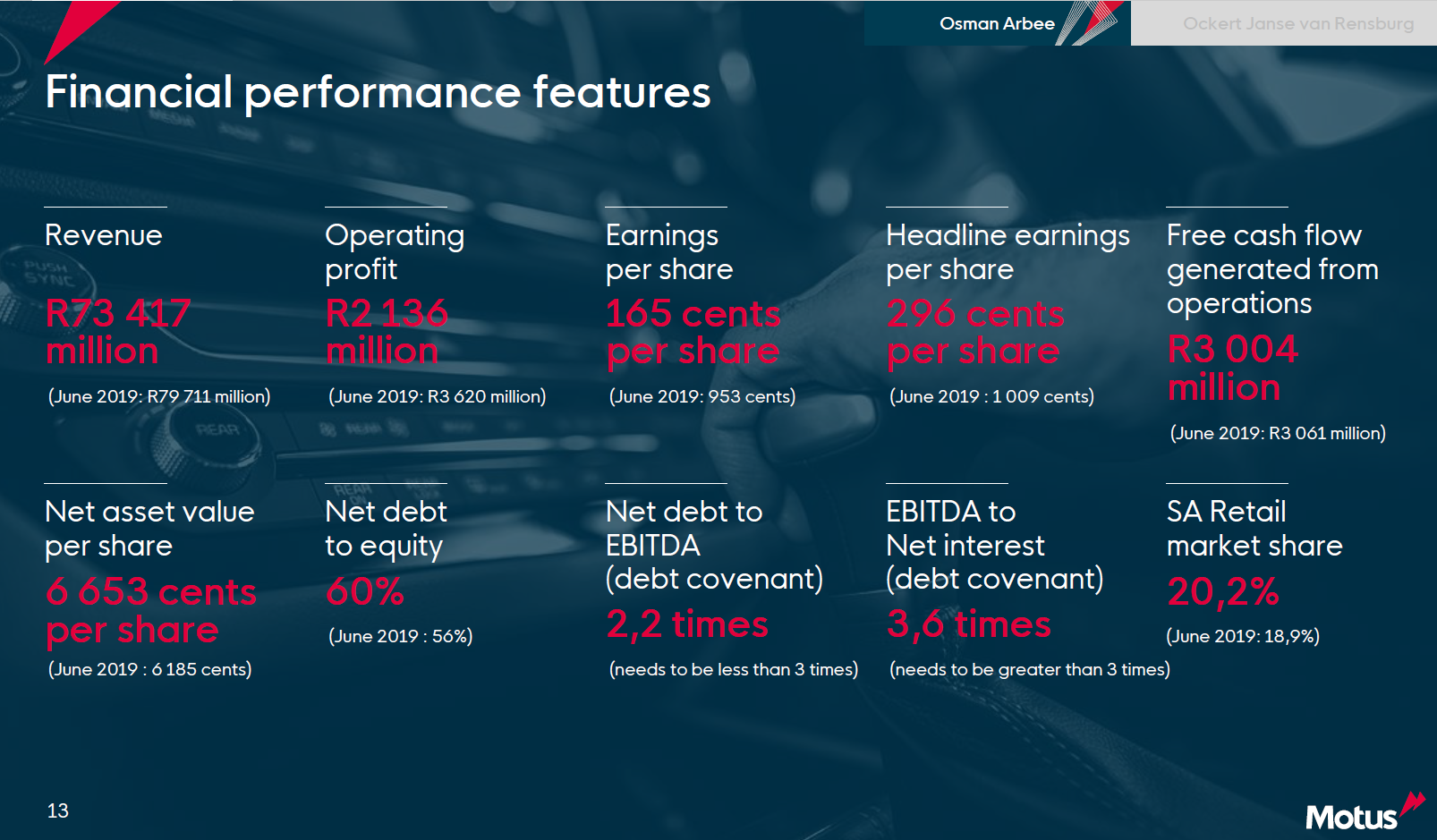
Group revenue declined by 8% to R73.4 billion from R79 billion in the previous year.
This reduction was attributed to 13% decline in vehicle unit volumes and lower parts and service sales, which was partly offset by an increase in selling prices and bolt-on acquisitions in the UK and Australia.
Osman said Motus still produced R2.1 billion of operating income compared to R3.6 billion last year with “six weeks of no trading and six weeks of very little trading” in all the countries in which the group operated.
The Covid-19 crisis resulted in a decrease in gross profit due to reduced sales volumes, lower margins because of the shift to entry level vehicles and more affordable parts and reduced car rental income, which was offset by reduced operating expenses due to cost containment.
Osman highlighted that Motus also still generated R3 billion in free cash flow from operations, which was very similar to the previous year without the Covid-19 crisis.
The norm for July and August is landing at 10 000 to 10 500 vehicles per month in South Africa. If I add on the UK and Australia we will get to 14 500 to 15 000 vehicles
Headline earnings per share dropped by 71% to 296 cents from 1 009 cents because of reduced trading activity and once-off costs related to restructuring.
Early retirement and voluntary and compulsory retrenchments costs amounted to R171 million in the year but Motus believes this will result in about R680 million in savings in the new financial year.
Motus did not declare any dividend for the year.
Despite the deterioration in the group’s financial results, Osman stressed there is “light at the end of this tunnel”. He said in the month of May when Motus only operated for two weeks in South Africa, the group sold 6 500 new and pre-owned cars.
In the month of June, when the group was still battling with licences and other things, it sold almost 8 000 cars. But he said in the months of July and August, Motus sold an average of 10 200 vehicles per month.
“So, yes, we are all sitting and working from home with the banks worried about their customer base and who will buy the cars. But people are still buying vehicles.
“The norm for July and August is landing at 10 000 to 10 500 vehicles per month in South Africa. If I add on the UK and Australia we will get to 14 500 to 15 000 vehicles.
“This helps the cash ability of this group to pay creditors and not to borrow more and to make sure it remains a sustainable cash flow business,” he said.
The contribution of the retail and rental business to the group’s total operating profit slumped to 14% in the year to June from 41% in the previous year.
However, Motus still increased its South African market share to 20.2% from 18.9% in a declining economy.
The full financial results presentation and presentation can be viewed at www.motus.co.za

South African car buyers are increasingly considering the full cost of ownership rather than focusing solely on the showroom price or monthly instalment.

A striking collection of Alfa Romeo vehicles, spanning immaculate classics to the latest performance models, will gather at Modderfontein Bird & Sculpture Park on Sunday 20 September for the 2026 Concorso d’Eleganza.

Kia South Africa has launched an upgraded Sonet range, with more safety, technology, and comfort across the line-up, backed by a five-year warranty with no kilometre limit.
 Advertisement
 Advertisement
Have you ever noticed that anybody driving slower than you is an idiot, and anyone going faster than you is a maniac?
George Carlin
A striking collection of Alfa Romeo vehicles, spanning immaculate classics to the latest performance models, will gather at Modderfontein Bird & Sculpture Park on Sunday 20 September for the 2026 Concorso d’Eleganza.

Suzuki Auto South Africa has moved into its new head office and distribution centre at Longlake Logistics Park in Gauteng, marking another important milestone in the continued growth of the business in South Africa, the manufacturer claims.

South Africa’s automotive market is undergoing a notable transformation, with growing sales and rising interest in newer brands. Among them, Foton has achieved a significant milestone, surpassing 7 000 vehicles sold locally within just two years of re‑entering the market.