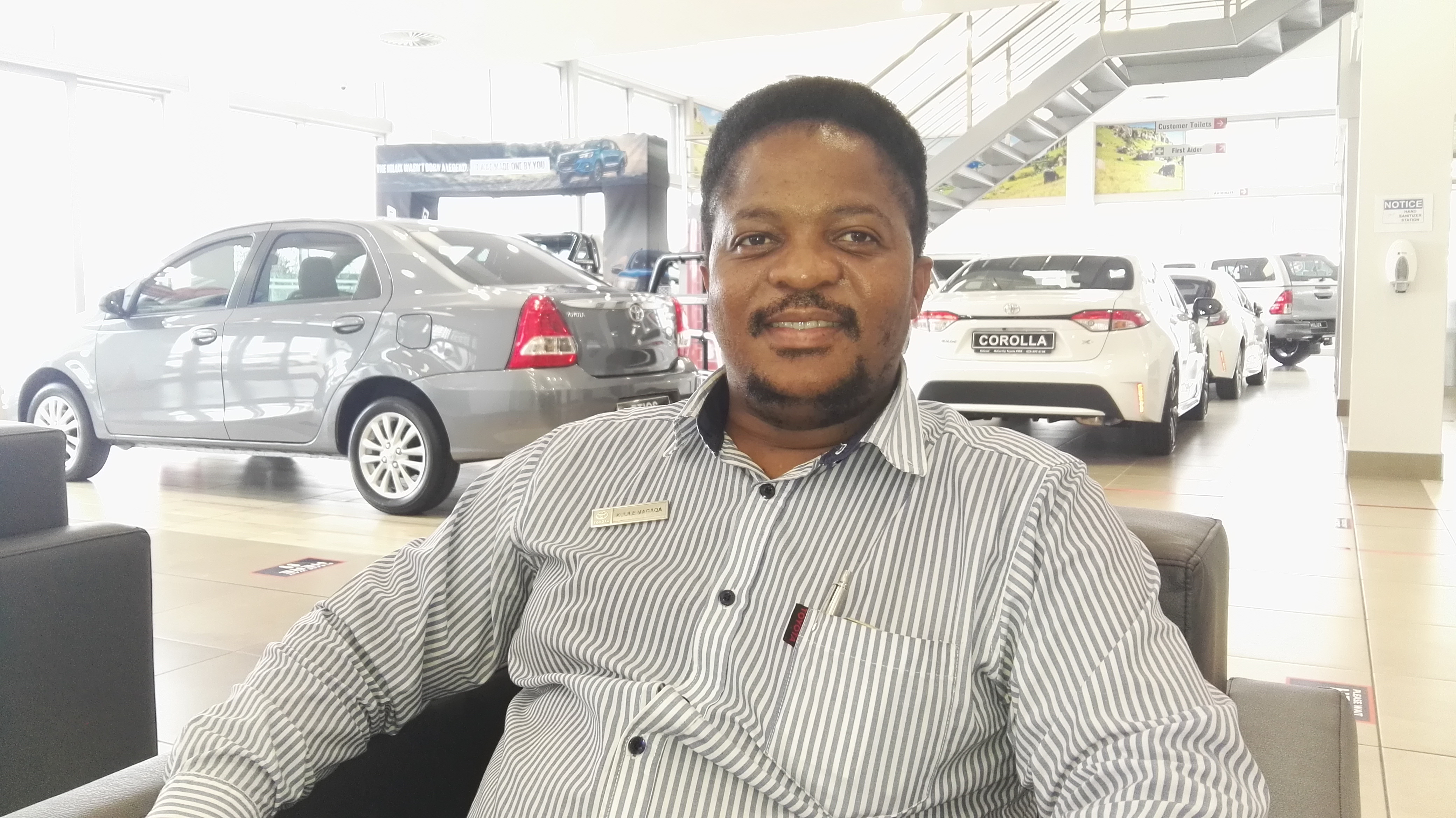
Kula Magaqa, new vehicle sales executive at Toyota in Pietermaritzburg gives good advice to the guys who buy Etios and Quest models to drive for ride-hailing apps like Uber and Taxify.
Share with friends
Magaqa said he read his competition’s praise song for the Nissan Almera alongside the Honda Amaze and Toyota Quest as excellent ride-hailer cars, but of course he rates the Toyota the better choice.
“But I’m not just saying so because of brand loyalty. I can show my clients the real fuel economy and how the boot space and leg-room compare for either the Quest or the Etios, and these are not even the most important reasons.
“The reason why I always recommend Toyota is because this brand holds its value so well,” Magaqa told Dealerfloor.
Magaqa said this future resale value makes it easy to recommend to his clients that they lease, rather than buy the car — especially to his ride hailing drivers.
Kula Magaqa, the ‘boyki from Mbotyi’ has good advice for ride-hail drivers.
He said Toyota sales staff have three ways for clients to finance a deal — Future Drive, what is known as a balloon payment in the trade; Instalment; or his favourite, Lease Finance.
He explained that with Lease Finance he can structure a deal for his clients to pay monthly rentals for anything from six months to 60 months, and at the end of the term put them in new wheels or refinance the vehicle, or even buy it with a balloon payment.
“I explain to my ride hailing clients that the Lease Option enables them to claim the full lease amount against tax, which makes an enormous difference at the end of the day. It means the state is subsidising you to operate your business by allowing you to claim back a big part of the running costs. This is a big benefit for anybody who is serious about growing his or her fleet business.”
He adds a lease option actually suits any driver who uses his or her Toyota to generate income, and those few whose employers still give them a car allowance.
Looking to the future, Magaqa predicts such leasing will become the norm among other dealers too.
“We don’t see it much here yet, this overseas trend of not wanting to own a car. For most people in South Africa, a car is still the basis of real independence. But as ride hailing spreads, the trend will come and I expect to eventually be leasing a lot more cars to people who use them for work, than to sell cars to proud owners,” says Magaqa.
The Kia Carens nameplate makes its return to South Africa, this time as a seven‑seater designed with families in mind. It combines Sport Utility Vehicle (SUV) styling with Multi-Purpose Vehicle (MPV) practicality, offering space, comfort and efficiency, Kia says.
Volvo has confirmed that its vehicles will now integrate Google’s Gemini artificial intelligence system. This development builds on the company’s existing collaboration with Google, which already provides Android Automotive OS and Google services in Volvo models.
New vehicle sales in 2026 continued their positive trend in April, with the 47 979 units sold marking the best April figure since 2013. This represents a remarkable performance by local automotive retailers despite a host of economic headwinds and a challenging trading environment.
CFAO‘s Mc Duling Motors under the leadership Allan Stiles as Dealer Principal scooped the top award as Dealer of the Year at VW’s recently held Grand Prix Awards.
The Isuzu Foundation, a collaboration between Isuzu Motors South Africa and its Dealer network, has raised more than R200 000 for thirteen children’s charities in Nelson Mandela Bay through its partnership with the IRONMAN4theKidz organisation.