Advanced driving instructor Daniel Barbosa and race driver Paige Lindenberg were shocked by the results.
“Too often we see people pushing their tyres to and beyond the legal limit. We know this is dangerous, but we wanted to put that theory to the test under typical road conditions,” explained Chris Farrar, Managing Executive at Tiger Wheel & Tyre.
“So, we set out to compare new tyres with 7 mm of tread to worn tyres with 2.1 mm, which is well within the legal limit of 1 mm, and took the cars through a series of tests simulating real-world driving conditions.”
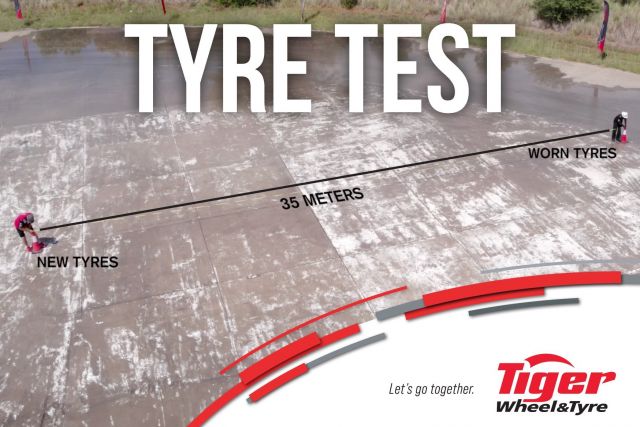
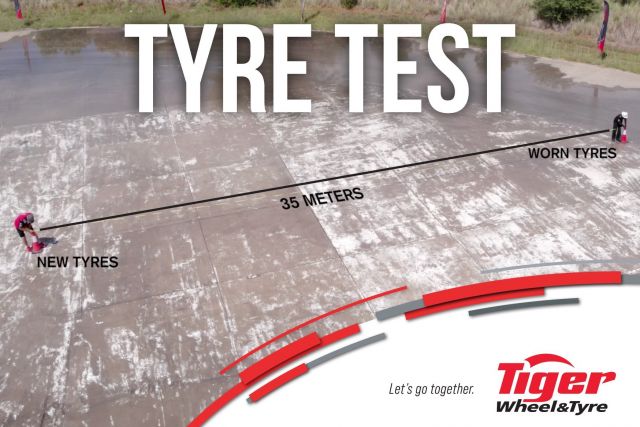
Straight Line Wet Braking: This test revealed a 10 m increase in the worn tyres’ straight line stopping distance at a speed of 60 km/h, compared to the new tyres, while that distance increased to as much as 35 m at 100 km/h.
Sweeping Right Turn: The test, which simulates taking a highway offramp in the wet, tested the tyres’ impact on their vehicles’ steering capabilities in a bend at 50 km/h. The new tyres adhered well to the road and comfortably made the bend, whereas the vehicle with worn tyres not only struggled to attain the testing speed but also suffered understeer.
Emergency Lane Change: This test simulated avoiding a collision on a wet road at a speed of 40 km/h, without braking. The new tyres effortlessly managed a controlled lane change without hitting any cones, while the worn tyres proved incapable of making the lane change and succumbed to understeer and hit the cones, which would mean a collision in real-world circumstances.
Slalom: The final test aimed to test steering input and traction in the wet at a slow 40 km/h pace on a slalom course. The new tyres demonstrated outstanding grip and performance, clearing the cones with ease. The worn tyres, on the other hand, made it past the first cone but couldn’t clear the remainder, as the worn tread proved incapable of evacuating water and maintaining contact with the road.
“The test results were very sobering and prove that a healthy tread depth is critical to vehicle performance and safety, and that the minimum legal tread depth of 1mm is no guarantee of either. What was also telling, is how shocked Paige and Daniel were by the differences in the new versus worn tyres. These are professionals whose daily work relies on good tyre performance. I think the key takeaway here is to never push your tyres to the limit of their lifespan,” Chris says.
Each tyre has a tread wear indicator (TWI) that indicates when the tread depth is at approximately 1.6 mm. The TWI is a series of ridges inside the tyre grooves and are aligned with a triangle on the sidewall for ease of location. If your tread is at or below the TWI, then it’s entirely likely that your tyres will not perform as well as less worn tyres tested by professional drivers.