Thousands of jobs created by Ford’s expansion drive
With International Workers Day on 1 May what better way to celebrate it than with an announcement of 1 200 new jobs created in South Africa’s motor industry.
Share with friends
When Ford Motor Company announced an investment of R15.8-billion in its South African manufacturing operations in February this year, it marked the biggest investment in the company’s 97-year history in this country.
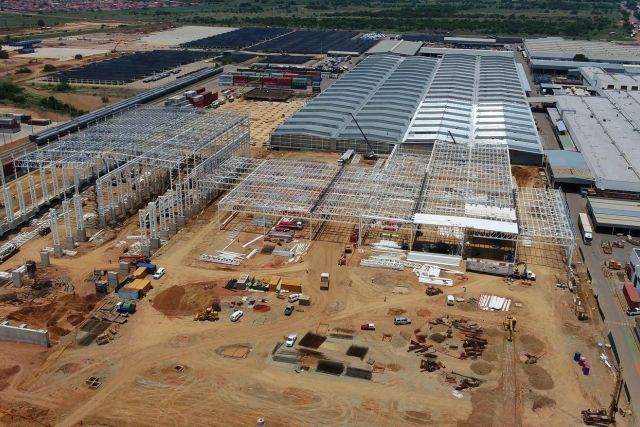
With a direct investment of R10.3-billion in the Silverton Assembly Plant in Pretoria, Ford will generate revenues exceeding 1.1 percent of South Africa’s gross domestic product. Furthermore, the expansion in manufacturing capacity to 200 000 vehicles per annum will be achieved with the construction of a new body shop, new high-tech stamping plant and a new chassis line.
At the centre of this expansion and increased manufacturing capacity will be the creation of 1 200 incremental Ford jobs, increasing its total workforce to 5 500 employees.
To promote further development of its employees, Ford is currently building a new training centre at the Silverton Assembly Plant to ensure that its team is equipped with the knowledge and skills required to maximise the efficiencies of the new, modernised facilities to produce the next-generation Ford Ranger, starting in 2022.
In addition to the new jobs created at Ford itself, the company’s local supplier network will benefit from the investment of R5.5-billion in tooling to support the expanded production. This will create an estimated 10 000 new jobs, taking the total number of jobs Ford supports in the total value chain to over 60 000.
Many of these suppliers will be located on the Tshwane Automotive Special Economic Zone (TASEZ), located adjacent to the Silverton plant. Ford is represented on the board of the TASEZ along with national, provincial and local government. This project is creating over 8 700 jobs during the construction of the first phase of the Special Economic Zone, with an estimated 2 100 incremental permanent jobs for operations.
Ford is also working closely with all three spheres of government and relevant state-owned entities in developing the Gauteng Province – Eastern Cape Province High-Capacity Rail Freight Corridor. This will be a full-service line linking the Silverton Assembly Plant and the TASEZ with Gqeberha (Port Elizabeth), which is home to Ford’s Struandale Engine Plant and the Coega Special Economic Zone.
Channelling all of Ford’s inbound and outbound logistics exclusively through Gqeberha to support the higher production volumes is projected to create thousands of additional jobs within the value chain.
The Kia Carens nameplate makes its return to South Africa, this time as a seven‑seater designed with families in mind. It combines Sport Utility Vehicle (SUV) styling with Multi-Purpose Vehicle (MPV) practicality, offering space, comfort and efficiency, Kia says.
Volvo has confirmed that its vehicles will now integrate Google’s Gemini artificial intelligence system. This development builds on the company’s existing collaboration with Google, which already provides Android Automotive OS and Google services in Volvo models.
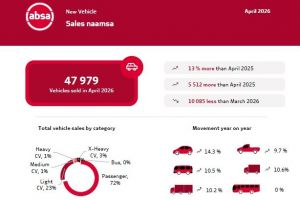
New vehicle sales in 2026 continued their positive trend in April, with the 47 979 units sold marking the best April figure since 2013. This represents a remarkable performance by local automotive retailers despite a host of economic headwinds and a challenging trading environment.
Volvo has confirmed that its vehicles will now integrate Google’s Gemini artificial intelligence system. This development builds on the company’s existing collaboration with Google, which already provides Android Automotive OS and Google services in Volvo models.
New vehicle sales in 2026 continued their positive trend in April, with the 47 979 units sold marking the best April figure since 2013. This represents a remarkable performance by local automotive retailers despite a host of economic headwinds and a challenging trading environment.
April 2026 marked a turning point in South Africa’s economic landscape, as global energy markets were jolted by escalating geopolitical tensions in the Middle East, according to naamsa | The Automotive Business Council.