SA’s automotive industry hits record exports as Chinese brands reshape local market
Strong demand, booming exports and a flood of new Chinese entrants are transforming South Africa’s automotive sector at a pace rarely seen before.
Share with friends
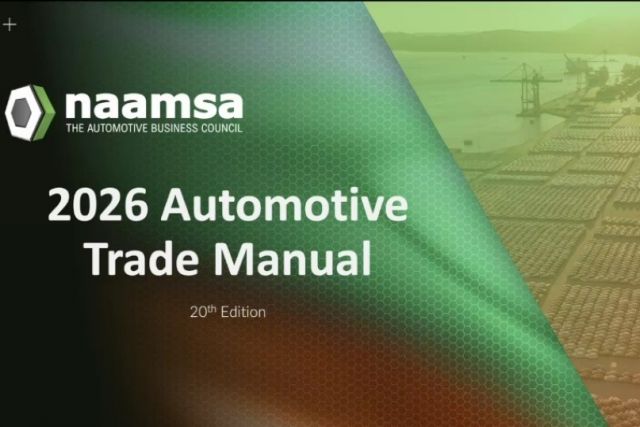
The Automotive Business Council has released its 20th annual Automotive Trade Manual 2026, the official reference for key industry data in South Africa. First published in 2007, the manual provides a detailed account of the country’s automotive export and import performance under the Automotive Production Development Programme (APDP) and its successor, APDP Phase 2 (APDP2).
The report paints a picture of an industry balancing strong export performance with intensifying competition from imported vehicles, especially from China and India.
Despite economic pressure and global uncertainty, the industry delivered record export earnings, higher vehicle sales and growing production volumes in 2025, underlining its importance to the country’s economy.
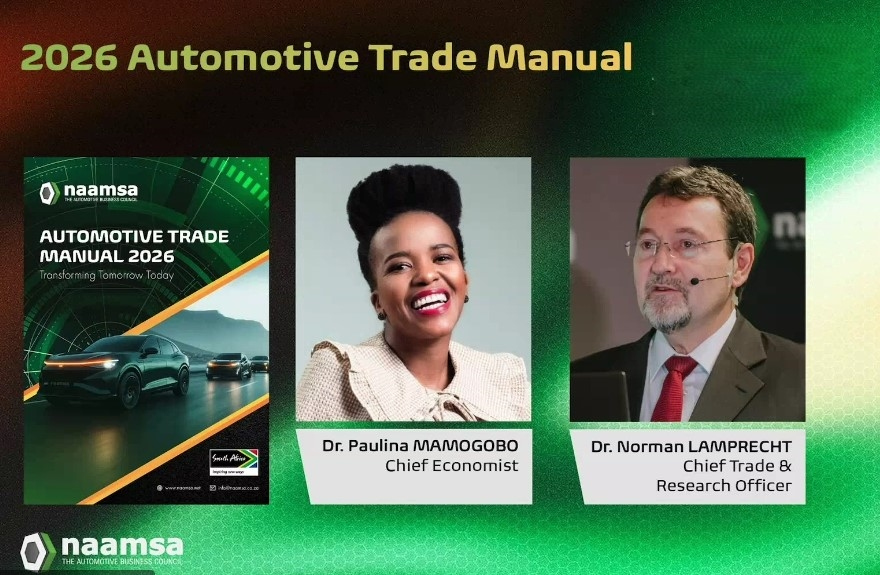
Dr Pauline Mamagobo and dr Norman Lamprecht presented the 2026 Automotive Trade Manual.
South Africa’s automotive industry achieved record export earnings of R291 billion in 2025, while new vehicle sales climbed sharply and local production expanded.
Automotive exports remained one of the biggest contributors to the country’s economy in 2025. Export value increased from R268 8 billion in 2024 to R291 billion in 2025, representing 15,6% of South Africa’s total exports.
Vehicle exports reached a new record of 414 271 units, up from 391 128 units the previous year. The value of exported vehicles rose to R229, 8 billion.
At the same time, the automotive sector accounted for 15,3% of South Africa’s total trade GDP under the Automotive Production Development Programme Phase 2, commonly referred to as APDP2.
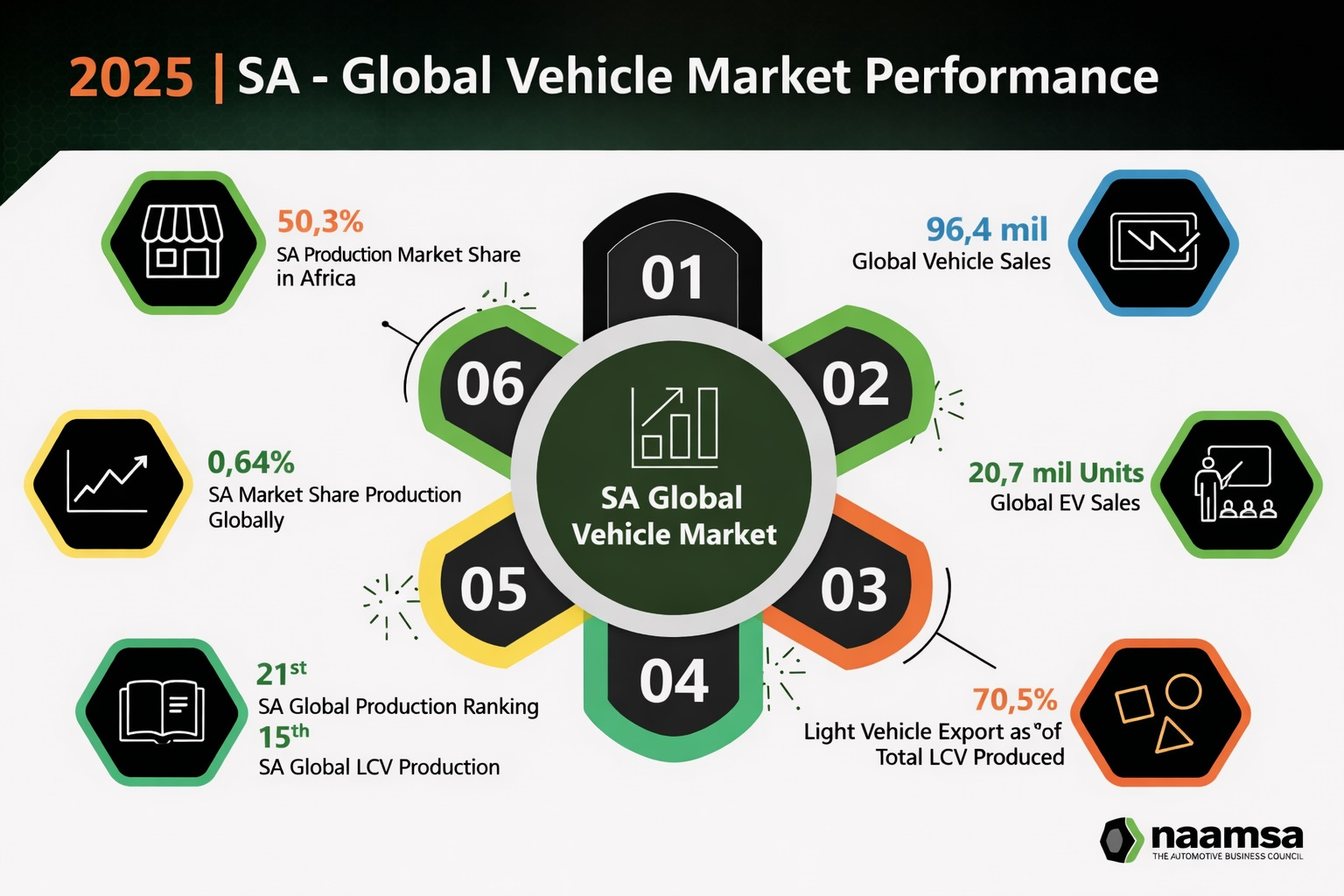
SA and Global vehicle market performance during 2025.
The broader automotive industry contributed 5,2% to South Africa’s GDP during 2025, with manufacturing accounting for 3,3% and retail activity contributing 1,9%.
Chinese brands gain momentum:
One of the biggest shifts highlighted in the report is the rapid rise of Chinese vehicle brands in the domestic market. According to naamsa, imported Chinese brands gained significant traction by offering competitive pricing, modern technology and long warranties.
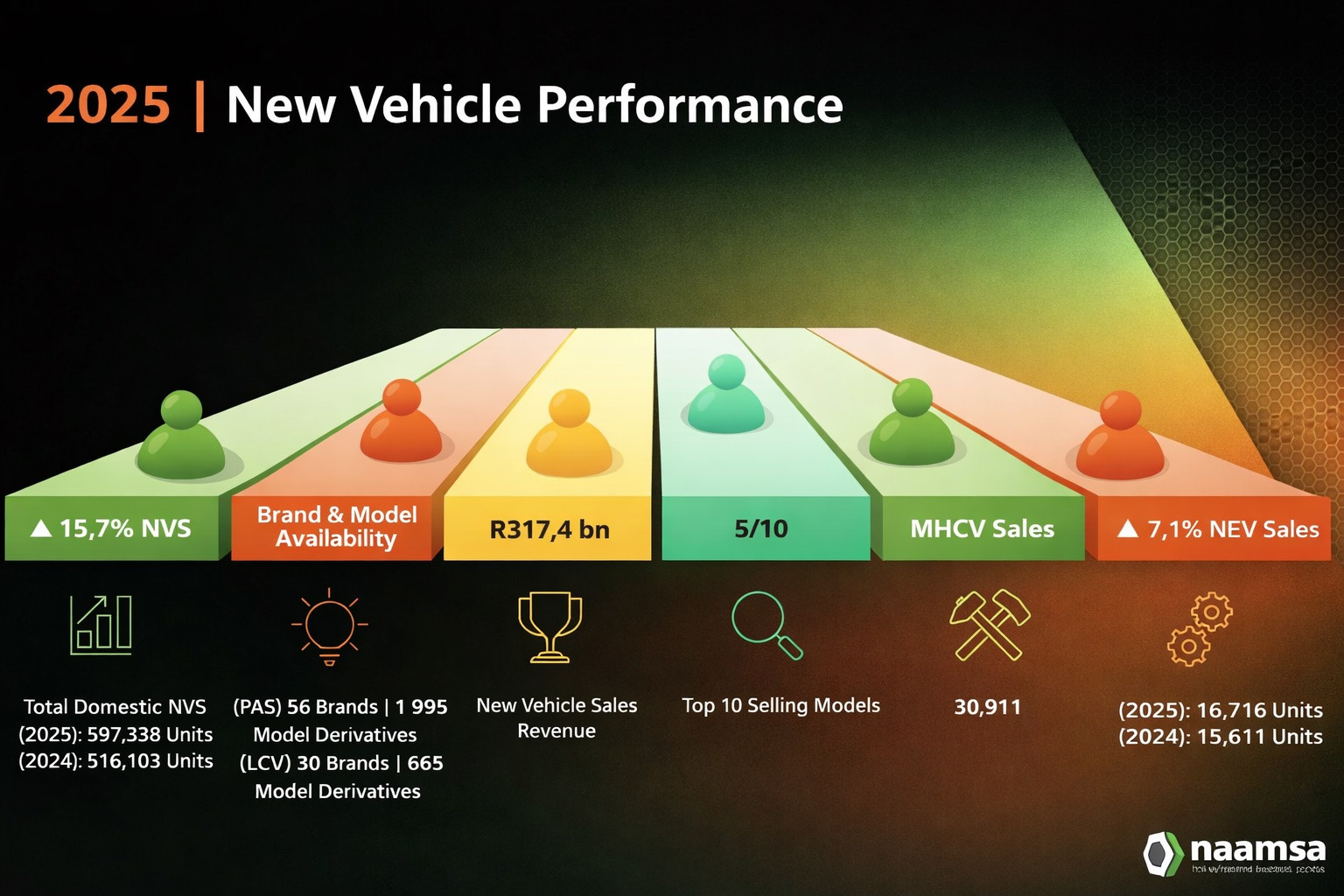
South Africa’s vehicle market has become one of the most competitive globally. During 2025 there were 56 passenger car brands available locally, offering 1 995 model derivatives. In the light commercial vehicle segment there were 30 brands and 665 derivatives available to buyers.
Chinese brands expanded aggressively during the year. There were 15 Chinese vehicle brands operating in South Africa during 2025, compared to only eight in 2024.
China also strengthened its position as a major source of imported vehicles. Imports from China climbed to 91 326 units in 2025, giving the country a 23,3% share of South Africa’s light vehicle imports, up from 17,1% the year before.
India remained the largest source of imported vehicles by volume, accounting for 219 796 units or 56,2% of total imports. Many of these vehicles were entry level and small cars targeted at affordability conscious consumers.
It is also noted that the Volkswagen Polo Vivo remained the only locally manufactured vehicle competing in the small and entry level passenger car segment during 2025.
New vehicle performance in South Africa during last year.
New vehicle sales rebound strongly:
Driven by lower interest rates, record low vehicle price inflation and broader model choice, South Africa’s new vehicle market recorded strong growth in 2025.
Total new vehicle sales increased by 15,7% to 597 338 units, compared to 516 103 units in 2024.
New energy vehicle sales also continued growing, although at a slower pace than the year before. NEV sales increased by 7,1% to 16 716 units in 2025.However, the share of NEVs relative to overall vehicle sales slipped slightly to 2,8%, down from 3% in 2024.
The report says global electrification trends are creating opportunities for South African component manufacturers capable of adapting to the transition. Research cited in the report indicates that South Africa has the potential to localise production of high value NEV components such as fuel cells, thermal management systems, e axles, battery mineral beneficiation and battery assembly.
Europe remains South Africa’s biggest export market:
Exports to the European Union (EU) and the United Kingdom (UK) reached R182,8 billion in 2025, accounting for 62,8% of the country’s total automotive export value. Light vehicles made up most of these exports, with more than four out of every five exported vehicles destined for the region.
Africa was South Africa’s second largest automotive export market, contributing R49,5 billion or 17% of total exports. Most of this value went to Southern African Development Community member states.
The report also highlighted growing optimism around the African Continental Free Trade Area. The adoption of new automotive rules of origin under AfCFTA from February 2026 is expected to create additional export opportunities across the continent.
Germany remained South Africa’s top vehicle export destination during 2025, followed by the UK, France, Belgium and Italy.
For the sixth consecutive year, the Volkswagen Polo was South Africa’s most exported vehicle model.
Imports continue climbing:
Light vehicle imports increased by 28,6% to 391 287 units during 2025. Imported vehicles accounted for 69,1% of total light vehicle sales, compared to 62,7% in 2024. Passenger car imports represented 82,8% of total passenger car sales during the year.
South Africa’s automotive sector also remained heavily dependent on imported components.
Imports of original equipment components used by local vehicle manufacturers increased to R151 billion in 2025. Replacement parts imports climbed to R107,5 billion.
Despite rising imports, South Africa maintained a positive automotive trade balance. The APDP2 trade surplus stood at R35,3 billion in 2025, although this was lower than the R42, 8 billion recorded in 2024.
South Africa still dominates African production:
Globally, vehicle production rose by 3,9% to 96,4 million vehicles in 2025. China remained the world’s largest producer with 34,5 million vehicles, followed by the United States, Japan and India.
South Africa produced 618 077 vehicles during 2025, up 2,9% from the previous year. Although the country’s global production market share slipped marginally to 0,64%, South Africa maintained its position as the 21st largest vehicle producer globally.
Locally, the country continued dominating African vehicle production, accounting for 50,3% of the continent’s total output and 46,5% of total vehicle sales in Africa during 2025.
Naamsa says the future growth of South Africa’s automotive industry will depend on stronger localisation, improved infrastructure and logistics, successful adaptation to new energy vehicles and continued policy support in an increasingly competitive global market.
Charging time remains a worry for many South Africans considering an electric vehicle, who still see it as a disruption rather than a quick stop at a filling station. That view is starting to shift.
The winners of the 2026 Automotive Business Council | naamsa Accelerator Awards were announced at the recently held Auto Week 2026, which took place in eThekwini, KZN.
When Cobus Coetzee (photo) accepted the opportunity to join the Morgan Group in Upington, he had to weigh up more than a new position. The move meant exchanging the West Coast’s cooler climate and seaside lifestyle for the Northern Cape’s desert heat, while taking responsibility for a multi-franchise operation spread across several premises.
The winners of the 2026 Automotive Business Council | naamsa Accelerator Awards were announced at the recently held Auto Week 2026, which took place in eThekwini, KZN.
With the steep rise in fuel prices since March this year leading to historic record highs following massive increases in October, the government intervention annouched this week, is widely welcomed.
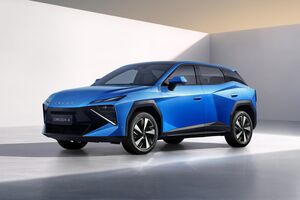
Omoda has confirmed that the new C4 will become the first model from the Chery Group to be built in South Africa, with production set to take place at the company's Rosslyn manufacturing facility in Gauteng.