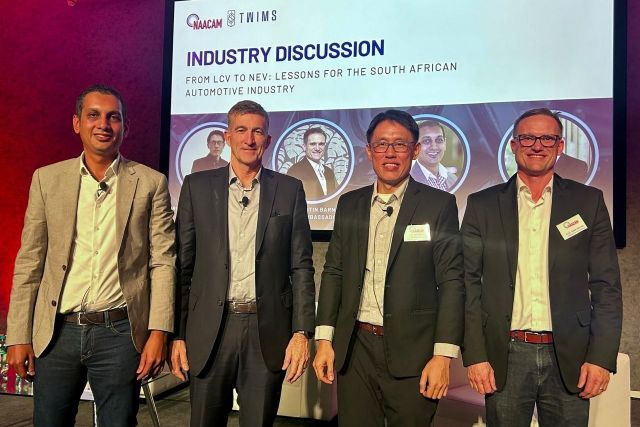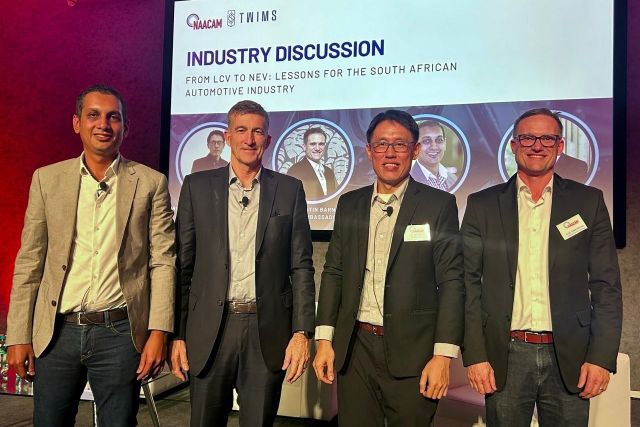
The keynote presentation was delivered by global academic expert Professor Kriengkrai Techakanont from the Thammasat University in Bangkok. He was then joined in a vibrant panel discussion led by Professor Justin Barnes of TWIMS, which included Renai Moothilal, NAACAM CEO and Andrew Kirby, CEO of Toyota South Africa.
In the late 1990s, South Africa and Thailand’s automotive sectors were comparable in size and key metrics. Today, Thailand’s sector produces three times more vehicles than South Africa and employs over 400 000 people.
Professor Techakanont’s address presented the strategic policies deployed by the Thai government to enable this growth and subsequent pivot into NEV production. Flexible yet consistent policies prioritising consumer demand linked production and component localisation were highlighted as fundamental for encouraging sector development.
Within the NEV transition, Thailand has successfully introduced tax incentives and consumer subsidies premised on the committed condition of local production of vehicles and components with penalties if those commitments are not met. This drives foreign direct investment and the deepening of the automotive value chain. Regional integration and bilateral trade agreements were equally noted as critical enablers of growth.
Building from the keynote address, the panel discussion reflected on lessons for the South African industry. There was a common view on key elements for increasing local production, similar to the model implemented by Thailand, which required tying both demand and supply side NEV incentivisation to production and localisation. Investment was also needed in Research and Development (R&D) and materials development to bolster value-addition in the sector.
Renai Moothilal commented that local suppliers have over the years migrated successfully through the industry’s technology changes and that every local component supplier has the ability and is ready to respond, irrespective of the propulsion technology.
This was no different to the cohort of Thai suppliers who at various stages moved from LCV to Eco Car, to NEV-targeted production. There is an opportunity to focus on different segments of OEM production and help prioritise the localisation of components, including those starting to emerge across different NEVs, including hybrids, to create scale in a low volume assembly environment.
Andrew Kirby highlighted the importance of the domestic vehicle market in supporting local production. He noted that South Africa was entering a phase of de-industrialisation which was evidenced in the sector by heightened sales of imported vehicles relative to those produced domestically and decreasing component localisation.
This amplifies the need for strategic industrial policy that promotes domestic sales and simultaneously incentivises OEMs to localise specific components. He suggested that the Thai policies of making locally assembled vehicles attractive to consumers were key.
South African produced vehicles were seen as 6%-12% more expensive to similar vehicles produced in Thailand and sold to their consumers. This meant the effective use of tax policies so consumers could help unlock domestic demand for local vehicles.
Professor Barnes noted that in his experience across different countries, successful policy institutionalisation and implementation have led to successful industries. There needed to be a flexible policy development process that fostered collaboration, and having all stakeholders from public and private sector fully embedded in the outcomes of this process.
- Main photo: Renai Moothilal; Andrew Kirby; Prof Kriengkrai Techakanont; and Prof Justin Barnes.