

Springboks score tries in Nissan Navara Pro4X
Two leading Springbok rugby players, Aphelele Fassi and Jordan Hendrikse, have taken delivery of their new Nissan Navara Pro4X bakkies in Durban.
- Industry News
- 12 May 2026
Events unfolding in the Middle East, combined with disruptions to oil shipping routes, have once again highlighted how dependent the world remains on crude oil and refined fuels.
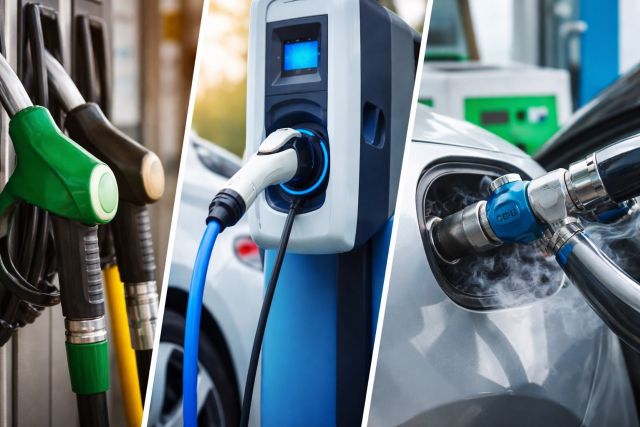
Tankers taking longer routes or failing to reach their destinations can tighten supply and push prices higher. For motorists this raises an obvious question. Is now the time to reconsider the type of vehicle you drive?
While petrol and diesel vehicles still dominate the global fleet, a range of alternatives is steadily gaining ground. Each has its own advantages, limitations and rate of adoption.
Understanding the current landscape provides a clearer picture of where the global car market is heading, according to the International Energy Agency (IAE) annual Global EV Outlook 2025.
Petrol and diesel still dominate:
Internal combustion engine vehicles remain by far the most common form of transport worldwide. Out of the more than one billion vehicles currently on the road globally, the overwhelming majority are powered by petrol or diesel engines.
These vehicles continue to account for a large share of new car sales as well, although the trend is gradually shifting. Global sales of petrol and diesel powered vehicles peaked around 2017 and 2018. Since then their share of new vehicle sales has slowly declined as alternative technologies gain traction.
In Europe, for example, petrol and diesel vehicles accounted for just 36.6 percent of new car sales in 2025. While this is still a significant share, it reflects a clear shift away from traditional powertrains.
Despite the gradual decline in new sales share, the sheer size of the existing fleet means petrol and diesel vehicles will remain a dominant part of global mobility for many years. Cars typically stay on the road for ten to fifteen years or longer, which slows the pace of change.
Electric vehicles gaining momentum:
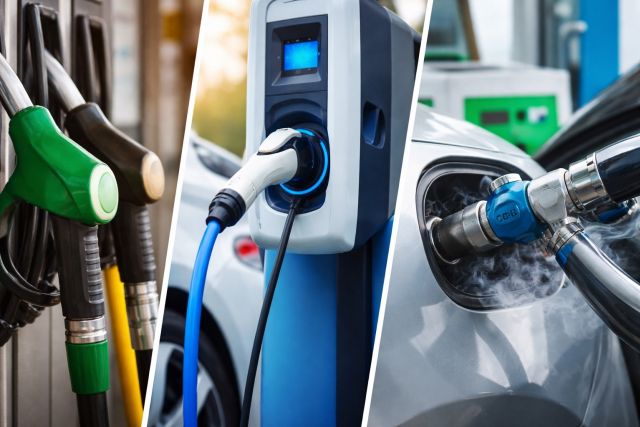
Electric vehicles are the fastest growing segment of the global automotive market. This category includes both fully battery electric vehicles and plug in hybrid models.
In 2024, nearly 18 million electric passenger vehicles were sold worldwide. That represented more than 20 percent of all new car sales globally, a remarkable increase compared with only a decade ago when electric vehicles were still a niche product.
The total number of electric cars on the road has also grown rapidly. By the end of 2023 there were roughly 40 million electric vehicles globally, and the number has continued to climb through 2024 and 2025.
Natural gas vehicles remain a niche option:
Another alternative that receives less attention is natural gas powered vehicles. These use compressed natural gas or liquefied natural gas instead of petrol or diesel.
The International Gas Union and the NGV Global Industry Association says globally the number of natural gas vehicles is estimated at between 11 million and 12.6 million units. Compared with the total global fleet this is still a relatively small segment.
Adoption is also concentrated in specific regions rather than being widespread. Around 44 percent of passenger natural gas vehicles are found in Latin America, while significant numbers are also located in parts of Asia, particularly India and China.
The technology can offer lower emissions and lower fuel costs in certain markets, but it requires specialised refuelling infrastructure, which has limited its expansion in many countries.
Compressed natural gas, commonly known as CNG, is the most widely used form of natural gas fuel for passenger vehicles. The gas is stored in high pressure tanks and used in engines that are similar in design to traditional petrol engines.
One of the main advantages of CNG vehicles is that they produce lower carbon dioxide emissions than petrol or diesel powered cars. The fuel is also often cheaper in markets where natural gas is abundant. On the downside, the driving range can be shorter, and refuelling infrastructure is limited in many countries, which restricts wider adoption.
Liquefied natural gas, or LNG, is natural gas that has been cooled to a liquid state. This makes it more energy dense and allows vehicles to travel longer distances compared with compressed natural gas systems.
LNG is more commonly used in heavy transport such as trucks and buses rather than passenger cars. The main benefit is improved range and lower emissions compared with diesel. However, the technology requires specialised storage tanks and fuelling infrastructure, making it more expensive and complex to deploy widely.
A market in transition
The global automotive market is clearly in the middle of a transition. Petrol and diesel vehicles still dominate the roads, largely because of the vast number already in circulation. Electric vehicles are expanding rapidly and are expected to play an increasingly important role in future mobility.
Rising fuel prices or disruptions in oil supply can accelerate interest in alternatives, particularly electric vehicles.
Two leading Springbok rugby players, Aphelele Fassi and Jordan Hendrikse, have taken delivery of their new Nissan Navara Pro4X bakkies in Durban.

Dealership service departments know the pattern: the moment warranties and service plans expire; a portion of owners quietly migrate to the independent aftermarket.

Mercedes-Benz Vans South Africa announced its top-performing Agents and Dealers for 2025, recognising their exceptional dedication, customer service and commitment to the brand.
 Advertisement
 Advertisement
I have bad reflexes. I was once run over by a car being pushed by two guys
Woody Allen
Two leading Springbok rugby players, Aphelele Fassi and Jordan Hendrikse, have taken delivery of their new Nissan Navara Pro4X bakkies in Durban.

The Board of Management of Volkswagen Group Africa (VWGA) has appointed Dr Lungile Mashele as Non-Executive Director, effective 1 May 2026.
Brazil has climbed back to the top of the global league table for Chinese outbound investment, drawing 10.9% of the total in 2025, according to the Brazil-China Business Council.