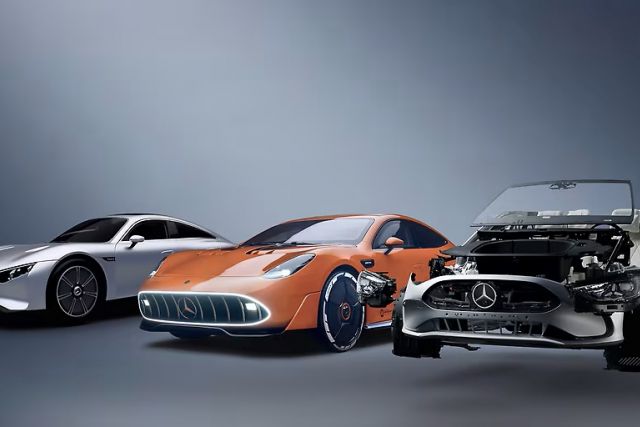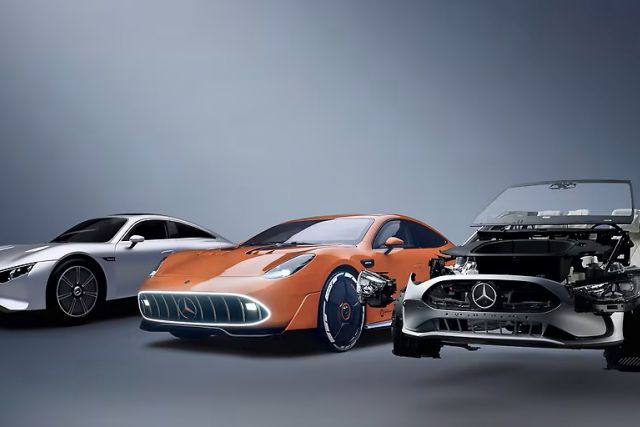
Revealed in December 2025, the programme moves far beyond previous one‑off concept projects in the “XX” innovation family, expanding the company’s ambitions from individual prototypes to a comprehensive, brand‑wide approach.
Rather than a single car or showpiece model, Tomorrow XX represents a strategic framework that reimagines how vehicles should be conceived, manufactured and ultimately dismantled. Its purpose is clear: to drive down carbon emissions and reduce resource consumption from the earliest design sketches to the moment a vehicle reaches the end of its lifecycle.
Central to the initiative is a renewed focus on decarbonisation, circularity and intelligent material choices. Working closely with suppliers, academic partners and start‑ups, Mercedes‑Benz has already identified more than forty new materials and component concepts with improved sustainability credentials. While some are close to being production‑ready and others remain in early development, together they demonstrate how integrating environmental thinking into engineering can reduce impact without diminishing performance or quality.
A major emphasis lies in designing with circularity in mind. Components are being re‑engineered to make them far easier to separate, repair or recycle. One example is a newly developed headlight assembly that can be dismantled without damage thanks to screwed‑together rather than glued parts. This prolongs the component’s usable life and ensures its materials retain value when it is eventually recycled.
The programme also accelerates the shift towards mono‑materials, particularly single‑type plastics that can be recycled more efficiently. A noteworthy innovation is a PET mono‑sandwich composite used for certain interior elements, cutting the carbon footprint by around half compared with conventional materials and illustrating the advantages of a circular design philosophy.
Tomorrow XX further addresses carbon-intensive materials such as metals. Mercedes‑Benz is investigating how to increase the use of secondary aluminium and steel, alongside improving recycling methods for plastics and brake components. In some cases, these measures have the potential to reduce CO₂ emissions from individual parts by as much as 85 per cent.
At its core, Tomorrow XX signifies a major cultural shift within Mercedes‑Benz. Sustainability is no longer treated as an optional consideration but as a fundamental principle running through every stage of product development. By embedding environmental responsibility into design, production and end‑of‑life processes, the brand aims to progress meaningfully towards a fully circular automotive model.
Although many of the technologies and materials developed under the Tomorrow XX umbrella are still evolving or awaiting series production, the programme makes one thing unmistakably clear: Mercedes‑Benz intends sustainability to be a defining attribute of its future vehicles and a benchmark for the wider industry.