EU – especially Germany – SA’s main trading partner
South Africa and its automotive industry are set to build resilience in 2025 and strengthen their trading position amid rising geopolitical uncertainties.
Share with friends
The domestic automotive industry’s top automotive regional trading partner in 2024 remained the European Union (EU), according to data in the latest edition of the Automotive Business Council’s (naamsa) Automotive Trade Manual 2025.
Vehicle and automotive component exports to the EU increased by R9.6 billion, or 6.5%, from R147.1 billion in 2023 to R156.7 billion in 2024, mainly owing to a rise in the value of vehicle exports to the region.
Automotive imports from the EU decreased by R900 million, or 0.7%, from R139.4 billion in 2023 to R138.5 billion in 2024, in line with lower original equipment component imports from the region.
The EU, Africa and US-Mexico-Canada Agreement (USMCA) were the regions with a trade surplus in 2024. The largest deficit was recorded with the 48-country Asia region, including countries such as China, Japan, India and Thailand.
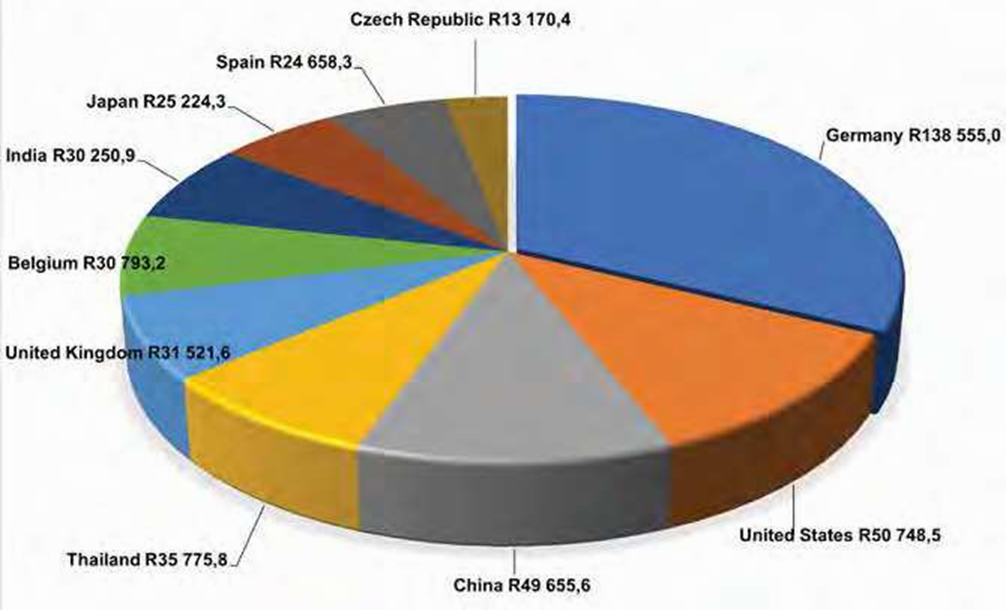
Germany, home to BMW, Volkswagen and Mercedes-Benz, remained the South African automotive industry’s biggest single trading country partner (exports and imports of vehicles and components combined) in 2024. Despite decreasing from the R161.1 billion in 2023, total automotive trade between the two countries still reached a significant R138.6 billion in 2024.
The South African automotive industry’s trade relationship with five of its top trading countries reflected a surplus in 2024. There were no changes in South Africa’s top 10 automotive trading partners, but China improved its ranking year-on-year in 2024.
The global transition to EVs is reshaping South Africa’s automotive export landscape considering the decrease in exports for internal combustion engine (ICE) vehicle components over the past two years. Four OEMs are currently manufacturing hybrids and plug-in hybrid models (Toyota, Ford, Mercedes-Benz and BMW) in the domestic market, while several localisation opportunities for EV components have been identified or already exist and should contribute to offset the losses in ICE vehicle component exports over the medium term.
South Africa’s main automotive regional trade partners – 2024:
As fuel prices continue to climb across South Africa, many motorists are beginning to question whether owning a car still makes financial sense. With in-land petrol prices now at R26.63 a litre and diesel costs rising sharply in May, transport expenses are placing growing pressure on household budgets.
Pinewood.AI has added two new embedded modules to its Business Intelligence Solution, giving dealers and OEMs greater insight into financial performance and the customer journey, it says.
Pinewood.AI has added two new embedded modules to its Business Intelligence Solution, giving dealers and OEMs greater insight into financial performance and the customer journey, it says.
Margins are shrinking, customers are under financial strain, and competition is intensifying across South Africa’s motor retail sector. Against this backdrop, dealerships are being forced to rethink how they remain profitable while still building customer trust and long term sustainability.
Ford will launch seven new models in Europe by 2029, it announced recently, as it seeks to grow its flagging passenger car sales, fend off fierce competition from Chinese rivals and maintain an edge in the continent's commercial vehicle market.