Counterfeit parts a growing threat to automotive industry
Counterfeit automotive parts present a significant and growing challenge across South Africa’s automotive aftermarket, impacting safety, operational reliability and the broader economy.
Share with friends
So says Vijay Mawalall, Head of Sales - Africa, ZF Aftermarket, regarding this growing threat.
“Key stakeholders, including dealerships, distributors, fleet operators, workshops, regulators, compliance bodies and industry associations, face severe risks owing to the infiltration of substandard components. These parts, often produced with inferior materials and lacking rigorous testing, can cause premature mechanical failures, accidents and costly downtime,” Vijay says.
Economic pressures, combined with ageing vehicle fleets, which average 12 years or more, have heightened demand for cheaper parts. This market dynamic, along with the rise of anonymous online marketplaces, facilitates the proliferation of counterfeit parts, further complicating detection and enforcement efforts. Border control and customs are often overwhelmed by the volume of imports, many originating from sophisticated illegal networks.
Vijay Mawalall (Head of Sales - Africa, ZF Aftermarket).
He states that counterfeits don’t just compromise individual vehicle safety; they erode industry trust, disrupt supply chains, damage brand reputations and reduce tax revenues, ultimately threatening jobs and the economic sustainability of the transport sector. The ripple effects extend across sectors that rely on safe and reliable mobility, including logistics, mining, agriculture and fleet management.
To combat this entrenched problem, stakeholders must strengthen procurement protocols by sourcing exclusively from authorised distributors and accredited workshops, ensuring full traceability. Ongoing technician training is essential so workshops and fleets can confidently identify counterfeits and refuse suspect parts. Moreover, enhanced collaboration among regulators, law enforcement, customs and industry bodies is critical to intensify inspections, monitor digital marketplaces and dismantle counterfeit supply networks.
Innovative anti-counterfeiting technologies, such as QR code verification, RFID tracking and blockchain-enabled traceability, are increasingly being adopted to enhance supply chain visibility and customer confidence. Transparency and accountability throughout the parts ecosystem are vital to preserving the integrity of the automotive aftermarket.
Addressing the counterfeit crisis requires concerted and coordinated action from all stakeholders to protect road safety, operational uptime and economic growth, Vijay says.
“Without decisive industry-wide measures, counterfeit automotive parts will continue to undermine one of South Africa’s most critical and economically significant sectors, hindering progress toward safer, more reliable and sustainable mobility for all,” he concludes.
ZF Aftermarket is the after-sales division of the German ZF group, which specialises in driveline systems, from gearboxes to suspension, in multiple commercial and private applications, from buses and trucks to heavy mining machinery, as well as cars as an OEM supplier to many well-known brands. It is also a leader in Automated Driver Assistance Systems (ADAS).
The Kia Carens nameplate makes its return to South Africa, this time as a seven‑seater designed with families in mind. It combines Sport Utility Vehicle (SUV) styling with Multi-Purpose Vehicle (MPV) practicality, offering space, comfort and efficiency, Kia says.
Volvo has confirmed that its vehicles will now integrate Google’s Gemini artificial intelligence system. This development builds on the company’s existing collaboration with Google, which already provides Android Automotive OS and Google services in Volvo models.
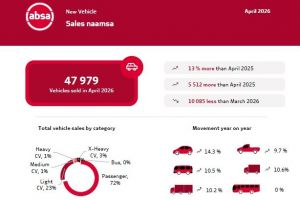
New vehicle sales in 2026 continued their positive trend in April, with the 47 979 units sold marking the best April figure since 2013. This represents a remarkable performance by local automotive retailers despite a host of economic headwinds and a challenging trading environment.
Volvo has confirmed that its vehicles will now integrate Google’s Gemini artificial intelligence system. This development builds on the company’s existing collaboration with Google, which already provides Android Automotive OS and Google services in Volvo models.
New vehicle sales in 2026 continued their positive trend in April, with the 47 979 units sold marking the best April figure since 2013. This represents a remarkable performance by local automotive retailers despite a host of economic headwinds and a challenging trading environment.
April 2026 marked a turning point in South Africa’s economic landscape, as global energy markets were jolted by escalating geopolitical tensions in the Middle East, according to naamsa | The Automotive Business Council.