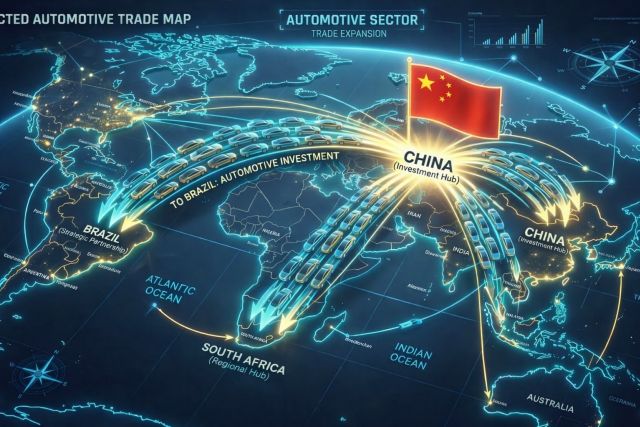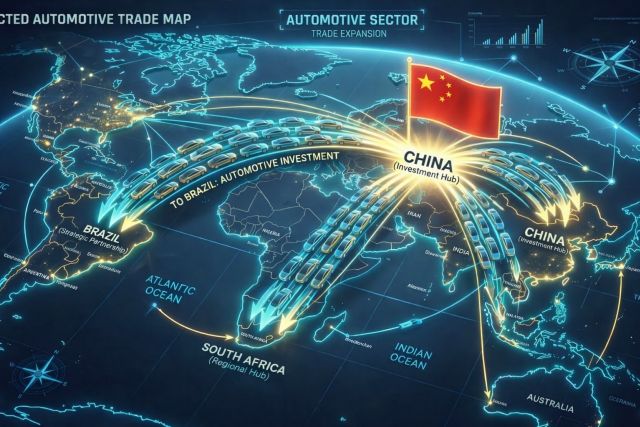
Chinese firms invested about R109 billion ($6.1 billion) in Brazil, up 45% year on year, as they widened their footprint beyond commodities into manufacturing aimed at local consumers.
For carmakers, the attraction is straightforward: scale, policy direction and ready-made industrial assets. In recent years, Chinese brands such as BYD and GWM have taken over plants previously run by Western manufacturers and repurposed them for electric and hybrid vehicle production, helping Chinese automotive investment rank among the top sectors flowing into Brazil.
Brazil’s weak currency, large consumer base, access to clean energy and raw materials are the same ingredients Chinese companies are scanning for globally as demand for lower-emission vehicles accelerates and trade frictions reshape supply chains.
South Africa sits on a comparable proposition, but with a different starting point. The country already hosts seven global vehicle manufacturers and more than 500 component suppliers, and the sector remains one of the economy’s most export-oriented industries. In 2024, South Africa exported 390 844 vehicles, with vehicles and components worth R268.8 billion, about 14.7% of total exports, according to naamsa, the Automotive Business Council.
What it Means for SA’s Car Industry
Pretoria is trying to ensure local factories do not miss the electrification wave. Government’s Electric Vehicle White Paper sets out a roadmap to shift from mainly internal combustion vehicles to a dual platform that includes electric vehicles by 2035, aligning with tightening rules in key export markets such as the EU and UK. Regulators have also published draft amendments to Phase 2 of the Automotive Production Development Programme (APDP) to include electric vehicles and associated components, signalling a push to keep investment anchored in South Africa as powertrains change.
That matters because Chinese brands are no longer just exporters of finished cars. As seen in Brazil, localisation can follow quickly once sales reach scale and policy certainty improves. In South Africa, Chinese marques have expanded rapidly in the showroom, and reports have pointed to plans by some manufacturers to explore local assembly, including models tailored to bakkie and SUV demand.
The prize is not only domestic sales but future-proofed exports. With Europe and the United Kingdom (UK) still absorbing a large share of South Africa’s vehicle shipments, the shift to hybrids and electric vehicles (EVs) is becoming a competitiveness test, not a niche trend.
If South Africa can pair its established supplier base with clearer incentives, more reliable energy and faster charging roll-out, it could position itself as Africa’s most credible alternative production hub as Chinese and traditional original equipment manufacturers (OEMs) redraw their global manufacturing maps.