
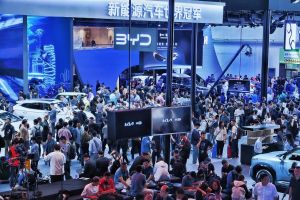
Auto China 2026 promises to be milestone event
Auto China 2026 marks another milestone in the evolution of an event that has tracked China’s rise from emerging market to global automotive powerhouse.
- Industry News
- 16 April 2026
Volvo Car South Africa has recorded a significant year-on-year increase in sales of its plug-in hybrid models, demonstrating the local market’s growing appetite for electrified vehicles from the Swedish luxury brand.
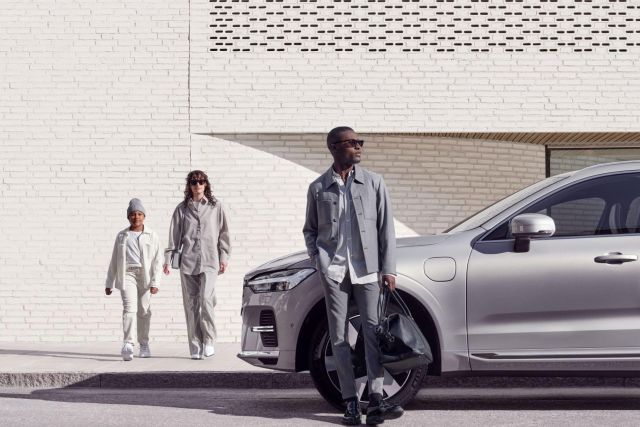
Over the first nine months of 2023, registrations of Volvo’s plug-in hybrid vehicles in South Africa grew by more than 33% compared with the same reporting period in 2022. This comes after the Gothenburg-based firm recently detailed its dominance of the fully electric premium C-SUV segment.
The XC90 Recharge plug-in hybrid – which is currently the flagship in the local Volvo line-up – was the key driver of this latest sales success, with local registrations of this model improving by more than 55%, year on year.
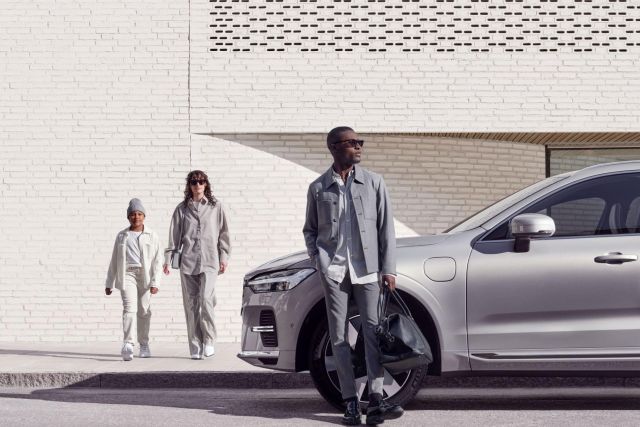
In addition, the XC60 Recharge plug-in hybrid continued to find favour among South African buyers, with sales of this model improving by a further 19% compared to the opening nine months of last year.
Both the XC60 and XC90 Recharge plug-in hybrids – which are both available locally in a choice of four derivatives – combine a turbocharged petrol engine with a rear-mounted electric motor fed by an upgraded 18.8 kWh lithium-ion battery pack. Total system outputs stand at a lofty 340 kW and 709 Nm in each case.
In addition to impressive levels of performance, the XC60 Recharge plug-in powertrain offers 81 km of all-electric range, while the XC90 Recharge plug-in hybrid delivers up to 77 km of likewise zero-emission driving (both figures based on WLTP data). Greg Maruszewski, Managing Director at Volvo Car South Africa, points to this capability as a key selling point.
“Thanks to an improved battery capacity, our XC60 and XC90 Recharge plug-in hybrids offer customers the choice of using electric power for much – if not all – of their everyday commute, while still being able to undertake longer journeys thanks to the petrol engine. It’s this flexibility that we see resonating increasingly with South African buyers,” Greg says.
Every derivative in Volvo Car South Africa’s range features some form of electrification, from mild hybrids to plug-in hybrids and fully electric vehicles. This is in line with Volvo’s goal of half its global sales volume comprising fully electric cars by 2025, with the remainder taking the form of hybrids. By 2030, the Swedish luxury firm plans for every new vehicle it sells to be completely electric, demonstrating its steadfast commitment to a zero-emission future.
Auto China 2026 marks another milestone in the evolution of an event that has tracked China’s rise from emerging market to global automotive powerhouse.
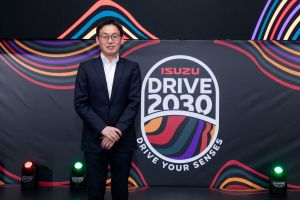
Isuzu Motors South Africa (IMSAf) has announced the appointment of Takashi Nishida as its new Chairman (Non-Executive Director), effective 1 April 2026.
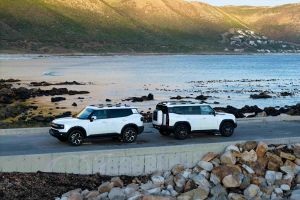
Jetour has quickly established itself in South Africa since its arrival in 2024, with the Dashing and X70 Plus paving the way for the rugged T-Series.
 Advertisement
Advertisement
Advertisement
Have you ever noticed that anybody driving slower than you is an idiot, and anyone going faster than you is a maniac?
George Carlin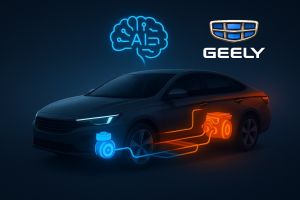
Geely Auto has lifted the curtain on a new hybrid technology that it believes can redraw the balance of power in a segment dominated for decades by Japanese brands.
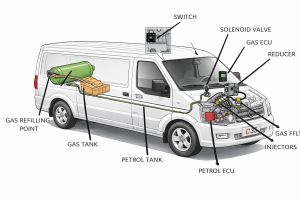
As fuel prices continue to place pressure on South African consumers and businesses, DFSK South Africa has introduced an LPG Autogas conversion solution aimed at reducing operating costs and improving vehicle efficiency across its petrol range.

Toyota Motor Corporation and Isuzu Motors are stepping up plans to bring hydrogen power into Japan’s light‑duty truck market, confirming a jointly developed fuel cell model scheduled for production in the 2027 financial year.