
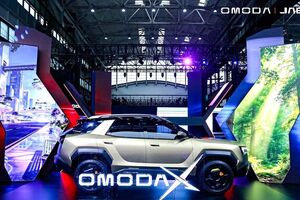
From Wuhu to Rosslyn: how the Omoda X and C4 share a design direction
In Wuhu, China, Omoda gave the Omoda X its global debut at Omoda X Night, held as part of the 2026 Omoda & Jaecoo International User Summit.
- Industry News
- 25 October 2026
Volkswagen Group is accelerating its technological reset in China as it prepares to base the majority of its locally built vehicles on its new China Electronic Architecture (CEA) by 2030.
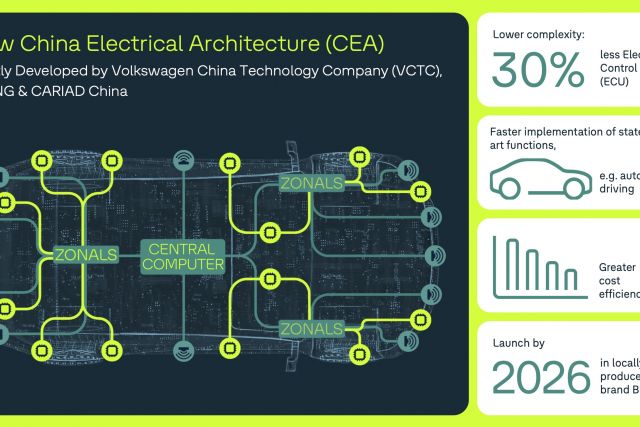
Initially developed with Chinese EV manufacturer XPeng, the platform is engineered to streamline vehicle electronics, allowing VW to cut development time by up to 30 per cent and sharply lower production costs through centralised computing and a reduced number of control units.
The first model built on the CEA, the ID. UNYX 07, entered production at Volkswagen’s Anhui plant at the end of 2025, marking VW’s transition into full software‑defined vehicle manufacturing within China. The architecture reduces electronic control units by around 30 per cent and supports over‑the‑air updates, China‑specific driver assistance technologies, and AI‑enhanced cockpit systems.
The shift comes as Volkswagen seeks to regain momentum in a market dominated by fast‑moving domestic champions such as BYD and Geely. The company’s sales slump in 2024, including a 17 per cent drop in the final quarter, pushed VW down to third place in China’s fiercely competitive landscape.
Though CEA originated as a joint development with XPeng, the partnership concluded in 2025. Volkswagen now oversees all software and hardware integration independently. Staff at the firm's Hefei technology hub describe having greater autonomy and an ability to deliver at “China speed” while still upholding Volkswagen’s reputation for safety and reliability.
Volkswagen plans to launch four more CEA‑based vehicles this year, before expanding the architecture to roughly ten additional models in 2027, including hybrids and combustion‑engine cars. This scalability, spanning electric, hybrid and ICE powertrains, is central to VW’s strategy of deploying a unified digital backbone and restoring its competitive edge.
As China becomes Volkswagen’s principal hub for software‑defined vehicle innovation, the CEA serves as a pivotal foundation for the brand’s long‑term transformation. It reflects a decisive shift towards faster development cycles, deeper localisation, and the adoption of China’s rapid‑iteration engineering culture, all critical factors shaping success in the world’s largest automotive market.
In Wuhu, China, Omoda gave the Omoda X its global debut at Omoda X Night, held as part of the 2026 Omoda & Jaecoo International User Summit.
Charging time remains a worry for many South Africans considering an electric vehicle, who still see it as a disruption rather than a quick stop at a filling station. That view is starting to shift.

The winners of the 2026 Automotive Business Council | naamsa Accelerator Awards were announced at the recently held Auto Week 2026, which took place in eThekwini, KZN.
 Advertisement
 Advertisement
I have bad reflexes. I was once run over by a car being pushed by two guys
Woody Allen
Charging time remains a worry for many South Africans considering an electric vehicle, who still see it as a disruption rather than a quick stop at a filling station. That view is starting to shift.
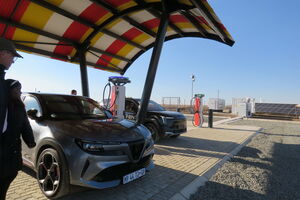
South Africa has taken important steps to position itself within the global electric vehicle (EV) industry, but industry stakeholders argue that further policy adjustments are needed if the country is to accelerate adoption and support long-term investment in clean transport infrastructure.
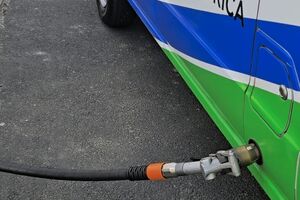
As fuel prices and operating expenses continue to challenge South African businesses, alternative energy solutions are receiving greater attention.