
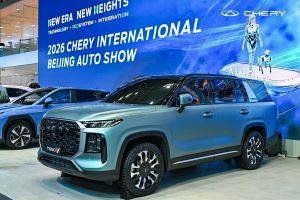
Chery Group showcase a variety of new vehicles
Brands in the Chery Group showcase their latest offerings at the 2026 Beijing Auto Show recently held in China.
- Industry News
- 29 April 2026
Although 99 per cent of trips motorists take falls in the less than 300km range, range remains a major factor when it comes to electric vehicle (EV) adoption hesitancy, as motorists want the peace of mind that a vehicle can do longer distances in the rare cases where it is needed.
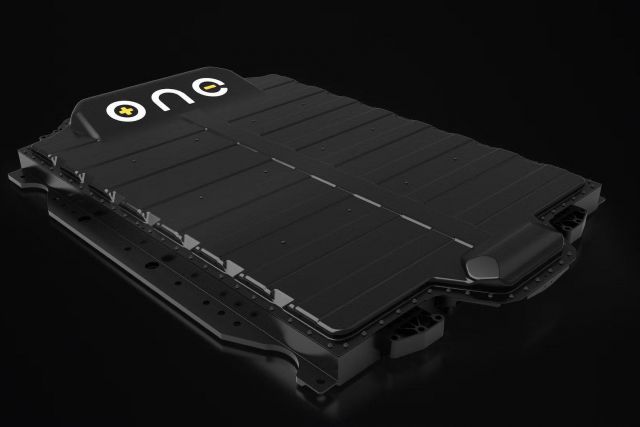
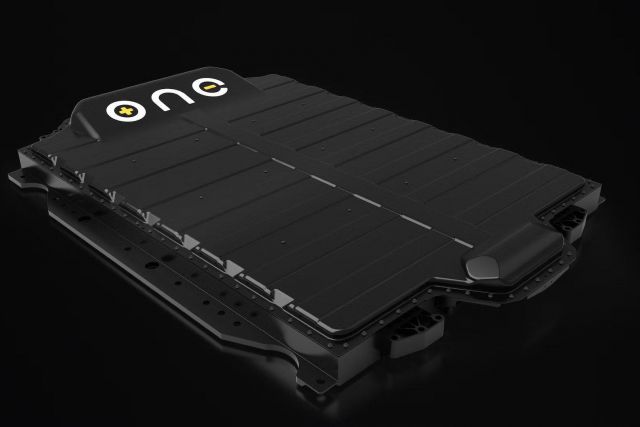
Michigan-based Our Next Energy (ONE) CEO, Mujeeb Ijaz, believes his company has the solution to providing highly extended range without massively increasing the expense and weight of an electric vehicle.
According to Ijaz, the solution is two separate batteries — one that is small and reliable for everyday driving and a second with an energy-dense chemistry to power the car on extra-long trips. Two different batteries with two different chemistries.
ONE’s dual battery project, called Gemini, leverages different battery chemistries to lower cost, increase safety and reliability and provide the edge-case range consumers seek.
According to ONE’s website: “Gemini is a complete platform designed to double the range of electric vehicles without compromising safety. It uses two cells: a lithium iron phosphate (LFP) cell for daily driving and an anode-free cell for longer trips. An AC-DC converter moves energy from between them seamlessly while our patented skip-cell architecture sharply reduces the risk of thermal runaway.”
It continues to explain that: “An LFP cell powers the motor and meets the demands of daily driving. Gemini’s LFP cell delivers 441 Wh/L, which produces a range of 150 miles on a charge — more than enough power for 99% of trips… After 150 miles, it switches to the anode-free cell, using it to charge the LFP cell. With an energy density of 1,007 Wh/L, the anode-free cell provides an additional 450 miles of range. Combined, the two cells will be one of the longest-range EV packs on the market — delivering more than 600 miles on a single charge.”
ONE goes on to claim that: “Gemini delivers more range than batteries that use nickel-and-cobalt-based chemistry. But Gemini maximises materials that are abundant in North America — iron for LFP, manganese for anode-free — while sharply reducing the use of rare, expensive metals like nickel and cobalt.
“Gemini’s anode-free cell lowers costs by using abundant materials and a simpler production process. As a result, we can bring our advanced anode-free chemistry to market faster. By replacing nickel, cobalt and graphite with other materials, Gemini greatly reduces the risk of thermal runaway. And our patented skip-cell architecture helps prevent overheating in the pack.
“All batteries have an anode and a cathode. But battery makers also use the term “anode” to refer to the active material placed on the battery’s current collector during the manufacturing process. This material may contain graphite or silicon. We create our “anode” without this material. Instead, during “formation” — an essential step during which the battery is charged and discharged — small amounts of lithium plate are deposited onto the current collector. This process forms the anode in our anode-free battery.”
In June 2022, ONE signed a demo agreement to integrate a Gemini battery into the BMW iX SUV, resulting in a confirmed range of 752 miles on a single charge.
Brands in the Chery Group showcase their latest offerings at the 2026 Beijing Auto Show recently held in China.
South African motorists are heading for another fuel price adjustment in early May, with increases likely to be driven mainly by global oil prices and a weaker rand, rather than additional tax changes.

Mahindra South Africa has announced a change to its key leadership position with Rajesh Gupta, current CEO of Mahindra South Africa, appointed as Regional Head for South Africa, Australia, New Zealand and South Asia for the parent company Mahindra and Mahindra.
 Advertisement
 Advertisement
You can't buy happiness but you can buy cars and that's kind of the same thing.
Unknown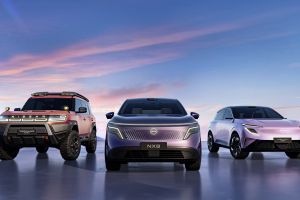
At Auto China 2026, Nissan unveiled two new NEV SUV concept cars, in its accelerated product rollout. It also highlights China’s role as one of the company’s lead markets and a global innovation and export hub, according to Nissan.
South Africa is experiencing its fastest shift yet towards electric mobility, driven not by environmental policy but by sheer economics.

Supporting the Pope on Africa soil in or on vehicles assembled on the continent, is the story of OPAIA Motors.