In its submission, CHARGE argues that the draft policy, in its current form, risks undermining private sector investment, delaying critical infrastructure rollout, and creating regulatory uncertainty at a pivotal moment in South Africa’s transition to electric mobility.
CHARGE’s submission raises several core objections to the draft policy, including:
- Exceeding statutory powers: The policy extends beyond SANRAL’s mandate under the SANRAL Act into areas such as land use planning, environmental regulation and commercial market structuring.
- Regulatory overreach and legal risk: Certain provisions may be unlawful and subject to review under the Promotion of Administrative Justice Act (PAJA).
- Conflict of interest: The policy positions SANRAL as regulator, market planner and potential participant, raising competition concerns.
- Investment uncertainty: Retrospective provisions and discretionary approvals risk undermining investor confidence and delaying infrastructure development.
- Competition law: CHARGE is also concerned that SANRAL’s proposed amendments to the RSF Policy risk violating key provisions of the Competition Act.
CHARGE cautions that these issues could have unintended consequences for South Africa’s broader economic and energy objectives.
“The rollout of EV charging infrastructure is time-sensitive and capital-intensive. It depends on a policy environment that is clear, lawful and supportive of investment,” said Joubert Roux, Co-Founder and Chair of CHARGE. “In its current form, the proposed RSF policy introduces uncertainty and overreach that could significantly constrain progress at a time when fuel prices are spiking, and electric mobility is critical to be independent and safeguarded from geopolitical volatility.”
CHARGE has called for the RSF policy to be revised to align strictly with SANRAL’s legislated mandate, limiting its scope to:
- Access and egress approvals – regulating how vehicles safely enter and exit national roads.
- Road safety considerations – ensuring that any development alongside national roads do not compromise traffic safety or road operations.
- Structures within building restriction areas – overseeing the placement of infrastructure within designated zones adjacent to national roads to protect road integrity and safety.
- Access levies administering fees associated with access to national roads, as provided for in legislation.
In addition, CHARGE has recommended that the policy:
- Clearly define the applicable legislative frameworks, with environmental matters governed by National Environmental Management Act (NEMA) and spatial planning governed by Spatial Planning and Land Use Management Act (SPLUMA) and relevant municipal authorities.
- Restrict transformation requirements to instances where SANRAL is a contracting party or landowner.
- Confirm that the policy will apply prospectively and exclude any retrospective impact on existing applications.
- Introduce clear administrative timelines in line with PAJA and principles of procedural fairness.
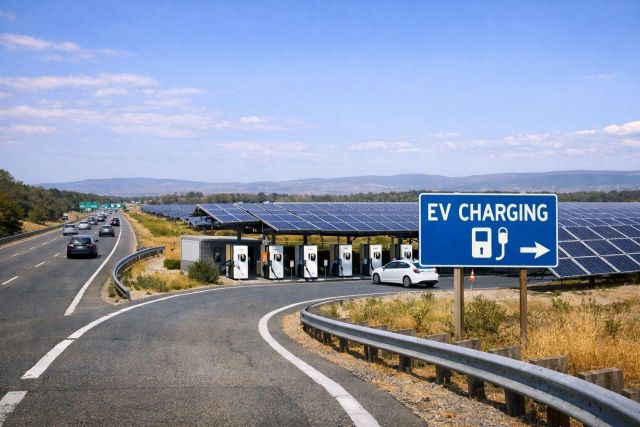
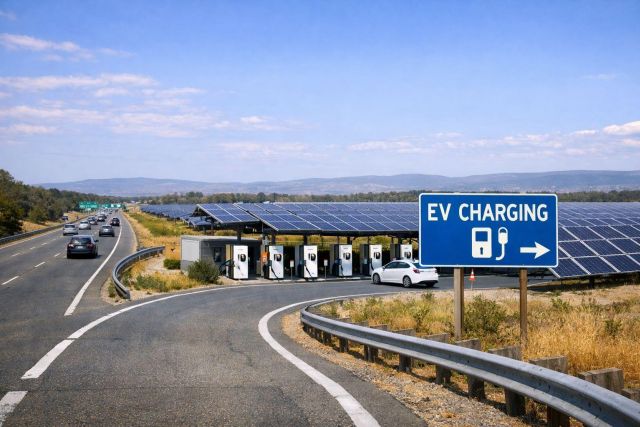
CHARGE’s off-grid EV charging network is designed to support long-distance EV uptake, EV travel, reduce pressure on the national grid, and unlock rural economic development. CHARGE’s rollout already includes a fully operational charging site at Wolmaransstad, with two new stations under construction along the N3 corridor between Johannesburg and Durban, scheduled to open in May 2026.
Image: AI generated