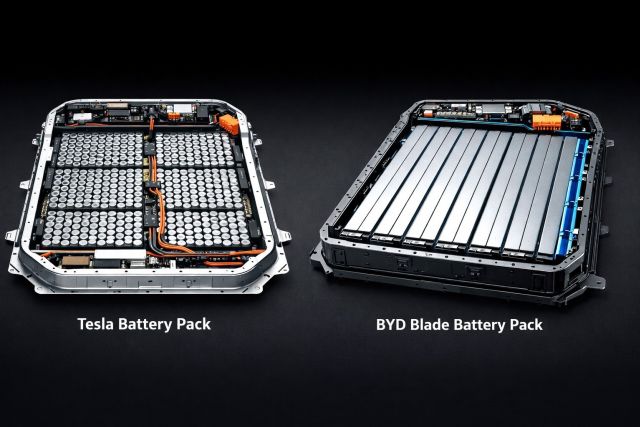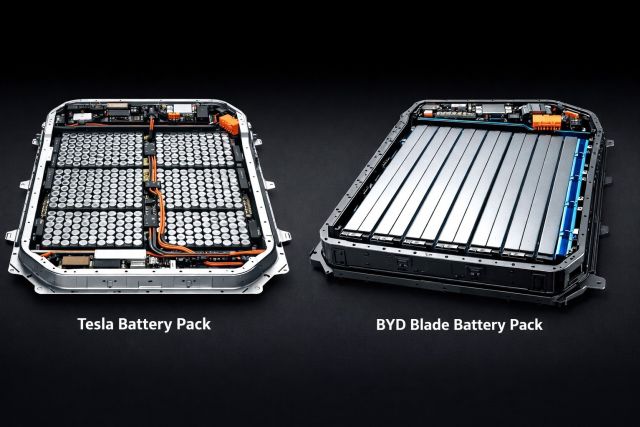
For electric vehicle (EV) batteries, teardowns are especially important because manufacturers rarely share full technical details. By opening the pack, researchers can see how cells are arranged, how cooling systems work, and what adhesives or reinforcements are used.
Battery teardowns are not quick or simple. They often require freezing, cutting and grinding to break down adhesives, and they must be done carefully to avoid damaging the components being studied. The results provide valuable insights into safety, cost and performance, helping both industry and consumers understand the trade‑offs behind different designs.
BYD bade battery - safety and simplicity:
A recent teardown of BYD’s Blade Battery revealed a 170‑cell pack that had been frozen for 40 hours to make the adhesive brittle. The dismantling took eight hours, with the team defending the slow process as necessary to preserve accuracy.
The findings showed:
- Direct cooling system using refrigerant, which makes heat management simpler and more efficient.
- Extensive structural adhesive, adding strength and safety but making recycling more difficult.
- Pack weight of 572kg, with energy density measured at 132Wh/kg at pack level.
- The battery endured cutting, grinding and hammering without catching fire, underscoring its reputation for safety.
This resilience highlights BYD’s focus on safety and durability. The Blade Battery is designed to reduce the risk of overheating and fire, which has been a concern in the wider EV industry. While it is less energy‑dense than some rivals, its emphasis on safety and cost efficiency makes it attractive in markets where affordability and reliability are more important than maximum driving range.
Tesla 4680 cell - energy density and performance:
By contrast, RWTH Aachen University in Germany’s teardown of Tesla’s 4680 cylindrical cell showed a design focused on high energy density and scalability.
Highlights included:
- Tabless architecture, which improves current flow and reduces resistance.
- Laser welding of electrode foils, instead of ultrasonic methods, allowing for more precise manufacturing.
- Use of novel binders in electrodes to boost efficiency.
- More complex thermal management, requiring advanced cooling systems to prevent overheating.
Tesla’s approach suits premium markets where long range and performance are priorities. The 4680 cell is designed for scalability in Gigafactories, making it central to Tesla’s strategy of mass production. However, the higher cooling demands raise complexity and cost, and they also increase the risk of thermal issues if not managed correctly.
Comparing the two approaches:
The BYD Blade and Tesla 4680 represent two different philosophies in battery design:
- BYD Blade: Safer, cheaper, easier to cool, but less energy‑dense. Larger packs may be needed for long‑range cars.
- Tesla 4680: More powerful and efficient, but requires complex cooling and higher production costs.
- Market impact: BYD’s design is strong in China and cost‑driven regions, while Tesla dominates in the US and Europe with performance‑driven models.
These differences reflect broader strategies. BYD is targeting mass adoption in cost‑sensitive markets, while Tesla is pushing the boundaries of performance and range in premium segments.
Why it matters?
Battery design is at the heart of the electric vehicle revolution. The BYD Blade Battery demonstrates how durability and safety can be prioritised, while Tesla’s 4680 cell shows the potential of high energy density for long‑range driving. Both approaches are shaping the future of electric mobility, and both are being closely studied by researchers worldwide.
The RWTH Aachen University study, published in Cell Reports Physical Science in March 2025, became one of the most widely read technical papers of the year, with more than 66 000 full‑text hits.
It provided quantitative insights into design trade‑offs, helping researchers balance performance, safety and cost. Meanwhile, the BYD Blade teardown reported by CarNewsChina in May 2026 gave the public a rare look inside one of the most talked‑about battery packs in the industry.
Together, these studies show that there is no single “best” battery design. Instead, manufacturers must choose between different priorities: safety versus energy density, cost versus performance, simplicity versus complexity. For consumers, this means that the choice of electric vehicle may depend not only on brand or price, but also on the underlying battery philosophy, according to the study.