A San Franciscan transport advocacy group, Safe Street Rebel, has found a novel way to further its aims.
Share with friends
The group, which by its own account “fight for car-free spaces, transit equity and the end of car dominance”, believes “people, community and park space must be prioritised over polluting, dangerous and murderous vehicles”.
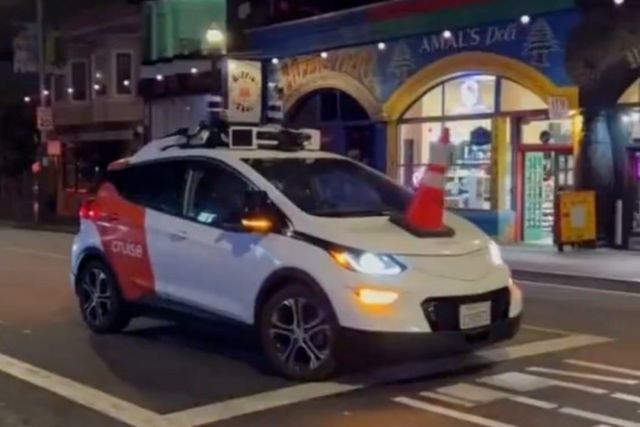
Earlier this week, as part of its “Week of Cone”-campaign, a Tik Tok video posted by the group went viral. In the video, the group encourages its followers, who are opposed to autonomous vehicles (AVs), to start placing the city’s many orange traffic cones on their hoods to disable them.
Over and above being a protest, it is also a way to highlight an important decision by the state regulator on whether to significantly expand robo-taxi services that were due to be made on July 13. This has been delayed until August 10, and Safe Street Rebel believes the delay is a sign of the success of the campaign.
The San Francisco Standard reported that the cones immobilise the autonomous vehicles by forcing them into “shutdown mode” with their hazard lights on, “until the cone is removed, or a company technician comes to reset the car’s system”.
For a substantial amount of time, Google’s Waymo and GM’s Cruise AVs have been causing havoc on the streets of San Francisco, including incidents where the vehicles interfered with emergency response teams and the killing of a dog.
Concerned activists also feel the AVs have become a new form of ubiquitous surveillance to aid the police department.
As fuel prices continue to climb across South Africa, many motorists are beginning to question whether owning a car still makes financial sense. With in-land petrol prices now at R26.63 a litre and diesel costs rising sharply in May, transport expenses are placing growing pressure on household budgets.
Pinewood.AI has added two new embedded modules to its Business Intelligence Solution, giving dealers and OEMs greater insight into financial performance and the customer journey, it says.
House lawmakers in the United States (US) have proposed bipartisan legislation that would require electric vehicles (EVs) to pay a R2 227 ($130) fee annually for road repairs, and R578 ($35) for some plug-in hybrid models, according to Reuters.
BYD is exploring the possibility of taking over underused car plants in Europe as it looks to expand its manufacturing base and strengthen its foothold in the region’s electric vehicle (EV) market.