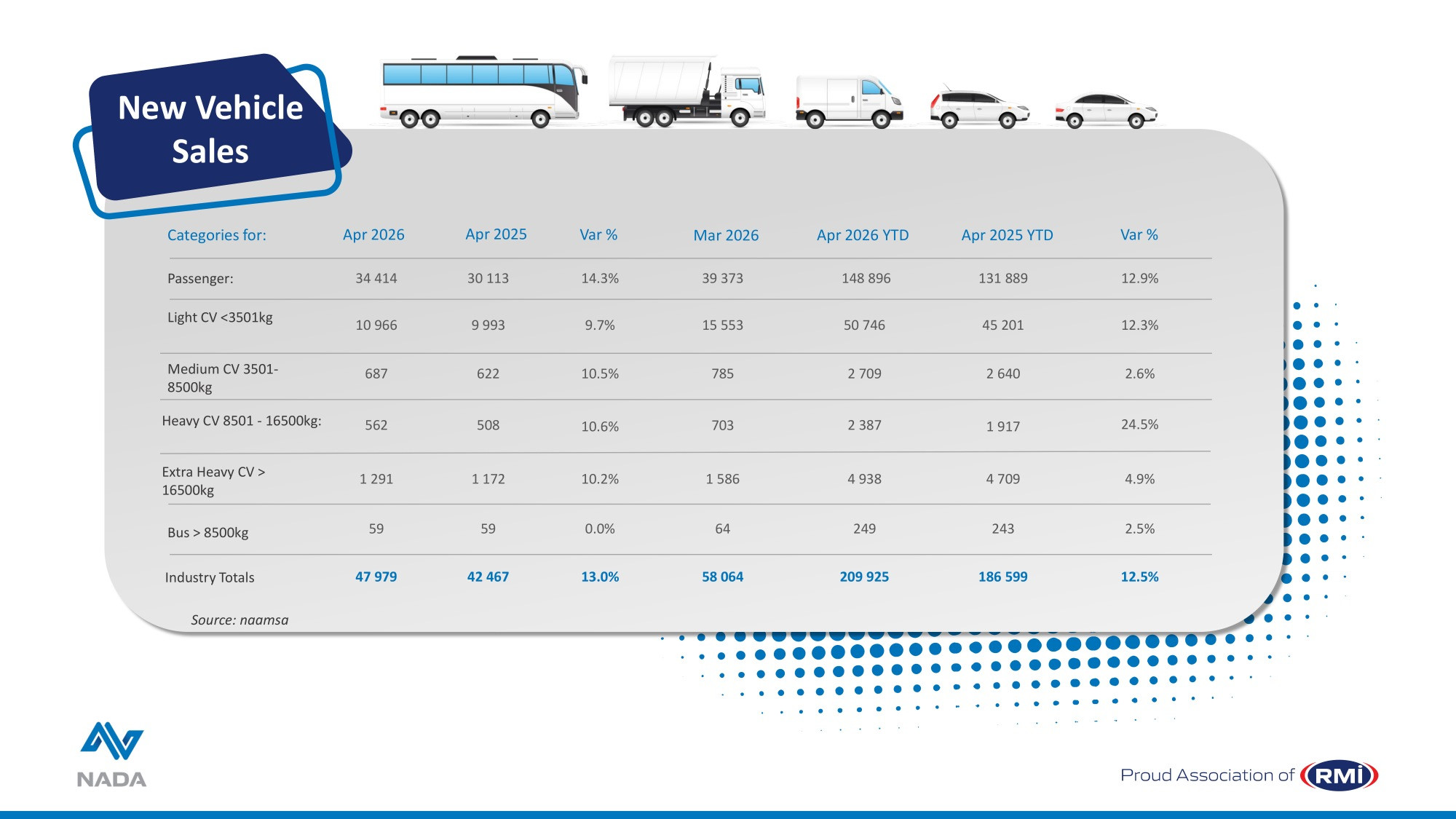
New vehicle sales in 2026 continued their positive trend in April, with the 47 979 units sold marking the best April figure since 2013. This represents a remarkable performance by local automotive retailers despite a host of economic headwinds and a challenging trading environment.
Share with friends
“This is an amazing show of robustness by local automotive retailers in a month featuring a host of public and school holidays, together with the turmoil caused by the Middle East conflict hanging over the global economy,” Brandon Cohen, National Chairperson of the National Automobile Dealers’ Association (NADA) comments, after studying the latest sales figures distributed by naamsa | The Automotive Business Council.
“General consensus was that these factors, together with the expected major increase in the price of fuel, would have put a dampener on the market. Not so. The passenger car figure of 34,414 units was an increase of 14.3% over the same month last year, while light commercials sold 9.7% more than in April 2025. Happily, the medium and heavy truck markets were in the black too, with mediums up 10.5%, while the heavy truck and bus market rose by 9.9%,” he says.
Dealerships navigate economic challenges:
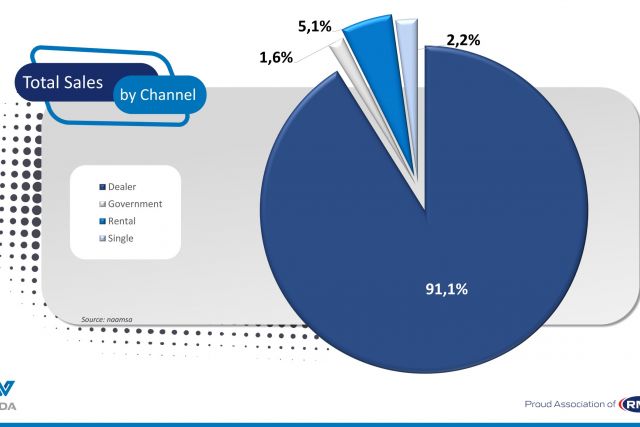
The resilience of the retail sector is highlighted by the fact that dealer retail outlets accounted for the lion’s share of volume, selling 91.1% of the total units in April. The remaining sales were split between the rental industry (5.1%), industry corporate fleets (2.2%), and government sales (1.6%).
Despite these positive overall numbers, the retail environment required adaptability. “It seemed dealers had to work harder to close deals, but many made good use of the holiday opportunities to promote their vehicles in the many shopping malls we have in South Africa. We also think there is a general feeling out there that new vehicle prices will increase significantly as the Middle East conflict continues to pressure vehicle and component manufacturers in terms of pricing,” Brandon adds.
Consumer caution and shifting preferences:
These global pressures are beginning to affect the financing and purchasing decisions of local motorists.
“We are obviously delighted at the continuing growth in sales, but this was somewhat unexpected. There were many applications for finance in the month of April, but the uptake wasn’t great. It seemed that many potential buyers were testing the waters in terms of what they qualify for and then decided to delay the actual purchase,” comments Thembinkosi Pantsi, National Vice Chairperson of NADA.
“While some buyers are pausing to assess their financial positions, those who are proceeding with purchases are changing their target segments.
“On the other side, we have seen consumers showing genuine interest in lower-priced vehicles, including demo models of Asian brands, as well as hybrid cars. However, older, good quality, traditional brands are still proving popular in the used car market,” Thembinkosi adds.
As fuel prices continue to climb across South Africa, many motorists are beginning to question whether owning a car still makes financial sense. With in-land petrol prices now at R26.63 a litre and diesel costs rising sharply in May, transport expenses are placing growing pressure on household budgets.
Pinewood.AI has added two new embedded modules to its Business Intelligence Solution, giving dealers and OEMs greater insight into financial performance and the customer journey, it says.
Pinewood.AI has added two new embedded modules to its Business Intelligence Solution, giving dealers and OEMs greater insight into financial performance and the customer journey, it says.
Margins are shrinking, customers are under financial strain, and competition is intensifying across South Africa’s motor retail sector. Against this backdrop, dealerships are being forced to rethink how they remain profitable while still building customer trust and long term sustainability.
Ford will launch seven new models in Europe by 2029, it announced recently, as it seeks to grow its flagging passenger car sales, fend off fierce competition from Chinese rivals and maintain an edge in the continent's commercial vehicle market.